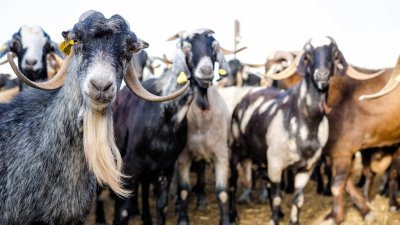
Rain is always a blessing from the heavens, especially in arid areas like Lanzarote. However, **excess water can have the opposite effect** on some primary sector activities, such as livestock farming. The negative effects impact, for example, **goats**, which are more accustomed to a drier climate.
In the case of Lanzarote and the lack of adaptation to rainfall that exists with regard to livestock, "the facilities are not designed for a rainy place like La Palma or Tenerife," says Omar Viñas, president of the Federation of Agricultural and Fisheries Associations (FASAT) and of the Association of Artisan Cheese Factories of Lanzarote (AQUAL).
Furthermore, goats have a peculiarity, and that is that they are more of a dry-land animal. Rain brings with it the proliferation of mastitis, a bacterial disease that causes udders to become inflamed, reducing milk production and quality. This leads to changes in the milk, such as the formation of lumps
Pneumonia is another of the conditions that appear with constant humidity derived from cold and rain. "It happens to them like it happens to people, think about them getting wet day and night," he assures. Likewise, Viñas points out that, although people may not believe it, "minimum temperatures can drop to five or six degrees." This causes some of the animals to die.
This winter weather also causes the animal to become immunosuppressed, meaning its immune system's capacity decreases, making it more susceptible to infections. One of the consequences of this is that goats stop eating. "In January, the females are weaned and milk production begins to increase, but this year that hasn't happened; rather, it has decreased because if the goat doesn't eat due to rain or cold, it doesn't produce milk," he explains.
Here lies the paradox of having green pastures all over the island that, due to weather conditions, the goats do not eat them due to lack of appetite. "If it were a cow or a sheep, they would be delighted, but the goats want nothing to do with water and it costs us a lot because much less milk is produced," he declares.
"In the end, if you weigh everything up, I'd say that **ranchers prefer there to be less grass** because, furthermore, it has rained very continuously and not like other years, where it rains a little, stops, and everything turns green again," he continues. And as Omar Viñas emphasizes, "the animal produces more milk as it has greater well-being."
A field that needs heat
Unlike livestock, the constant rains of the past month and a half have been very well received by farmers in Lanzarote, especially those who grow potatoes, one of the island's star products.
"For us, rain is a guarantee for being able to cultivate; there are people planting, and above all, it helps us with the summer harvest, which is planted in February and March, so **planting on wet ground is a joy**," says Noli Peraza, president of the 'Papa de Los Valles' Association.However, the problem farmers are now facing with the rain is that **the crop cannot be mechanized**, but must be done by hand. This is because when the soil is wet, tractors would cause the soil to mix with the rofeLikewise, Peraza points out that the potatoes planted in August, September, and October, which are being harvested these days, **have yielded a large harvest** because they have benefited from the rains that have fallen since November. "We haven't had to apply **any phytosanitary treatment** because, furthermore, the moth doesn't appear in cold weather," he reveals.Despite the copious rainfall, the type of soil in Lanzarote means that crops are not affected by excess water. "The layer of volcanic ash causes **the water to drain**; if it rained much more, there would indeed be rot problems due to excess moisture," he clarifies"There are farmers in Gran Canaria and Tenerife who normally plant in January, but this year they are considering that the period will pass them by and they won't be able to sow because it keeps raining and the land needs to air out," he continues.Regarding the cultivation of **onions**, Peraza assures that "this rain has been a godsend for them," although there is a type of onion called 'ajillo' "which the humidity does affect in the sense that the bulb becomes too large and bursts."Although the water is well received, the farmer states that "the fields already need heat because the land already has a reserve of water and moisture".
The winegrowers, the most benefited
The last month and a half of rain has ensured a good grape harvest in Lanzarote after years of little rainfall. Jorge Rodríguez, president of the Regulatory Council of Wine, was on the program Buenos días, Lanzarote this past Monday, where he explained how these rains have affected this crop.
The increase in rainfall has been joined by lower-than-normal temperatures being recorded on the island. "All of this has meant that, in the case of the vineyard, it is in an ideal dormant period for it, so for now everything is going quite well," he commented.
"We had been **dragging a very large drought for many years**, and this weather in the countryside has been received with open arms because if it hadn't rained this year, some areas of the island would have had a very hard time," he asserted.
Regarding the possibility of exceeding one million kilos of grapes in the harvest, Rodríguez explained that Lanzarote's average harvest is around two and a half million, so "it is feasible to reach that figure," but **we have to see how the pests develop and how the summer turns out**, whether it will be warm or not


Add La Voz de Lanzarote as a preferred Google source.
Stay informed with the latest current news.