
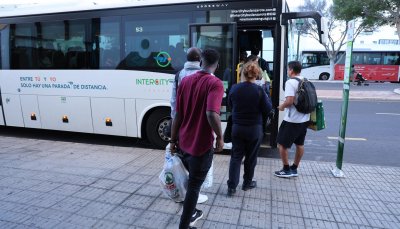
The Ministry of Public Works, Housing and Mobility, through the General Directorate of Transport and Mobility, headed by María Fernández, has signed the orders for the granting of monetary contributions to finance mobility policies linked to regular land public transport of passengers during the year 2025. These aids, which reach 10,720,000 euros, consolidate the Autonomous Executive's commitment to more sustainable, coordinated and accessible mobility throughout the Archipelago.
The funds are distributed among all the islands, with an investment of 4,288,000 euros for Gran Canaria and another 4,288,000 euros for Tenerife. Fuerteventura, Lanzarote and La Palma will receive 536,000 euros each, while La Gomera and El Hierro will have an allocation of 268,000 euros, respectively, which is done following the distribution criteria of the funds, which mainly takes into account the demographic weight of each island territory in the Archipelago as a whole.
Thus, Lanzarote is the island that receives the least funds per inhabitant, since the concession to the isla conejera is equivalent to 3.28 euros per resident. In Fuerteventura it is 4.23 euros, Tenerife (4.47), Gran Canaria (4.92), La Palma (6.27), La Gomera (11.9) and El Hierro (22.7).
The general director of Transport and Mobility, María Fernández, has stressed that "with these contributions, the Government of the Canary Islands continues to develop a determined policy to promote public transport, in coordination with the councils and island administrations, to prioritize collective use over the private vehicle".
Fernández also highlighted that this economic boost will allow to continue consolidating measures such as the Canarian Resident Bonus, which reduces the cost of the ticket for residents; as well as to advance in the application of digital technologies that facilitate the planning of trips and promote greater citizen awareness around the use of public transport.
"We are talking about investments that not only improve the day-to-day life of citizens, but also profoundly transform the way we move and conceive mobility in the Canary Islands. Betting on public transport is betting on equal opportunities, sustainability and cohesion between islands", he said.
To conclude, Fernández pointed out that "in a context in which free transport is already underway, these contributions become even more relevant, as they allow us to continue investing in everything else: improving the service, modernizing infrastructures and guaranteeing their long-term sustainability. In addition, they represent a breath of fresh air in the face of the State's delay in transferring the committed funds, which highlights the management capacity of this Executive".


