
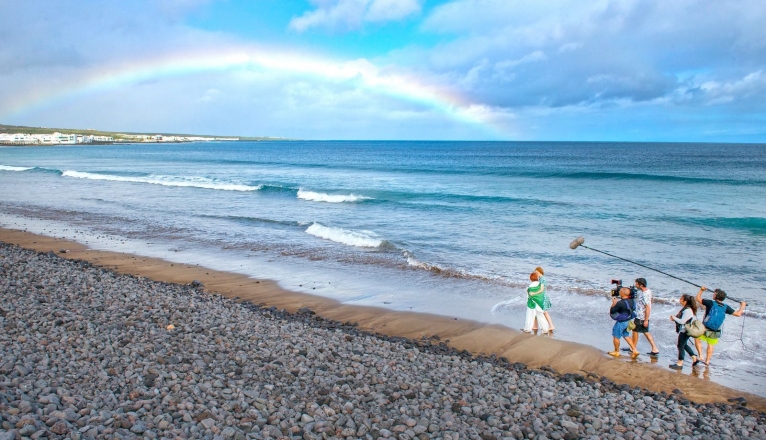
Lanzarote is in fashion in the world of film and series, as more and more film productions are deciding to come and film on the island, attracted by its striking landscapes and tax incentives.
Specifically, in 2020 film and series productions left almost 5 million euros on the island and it is estimated that the 2021 data will be even better, according to Ismael Curbelo, technician of Lanzarote Film Commission.
Foundation, from Apple TV, Bienvenidos al Edén from Netflix, Ethernals from Marvel or In the Heart of the Sea from Warner, have been some of the great productions that fell surrendered to the charm of Lanzarote, filming in places such as the Volcán del Cuervo, the Jardín de Cactus or La Geria.
On average, about four major shoots arrive per year, which translates into a great impact on the local economy of the island. Without going any further, in the production of Foundation an average of 800 workers participated, but there were days when they exceeded 1,000 people hired.
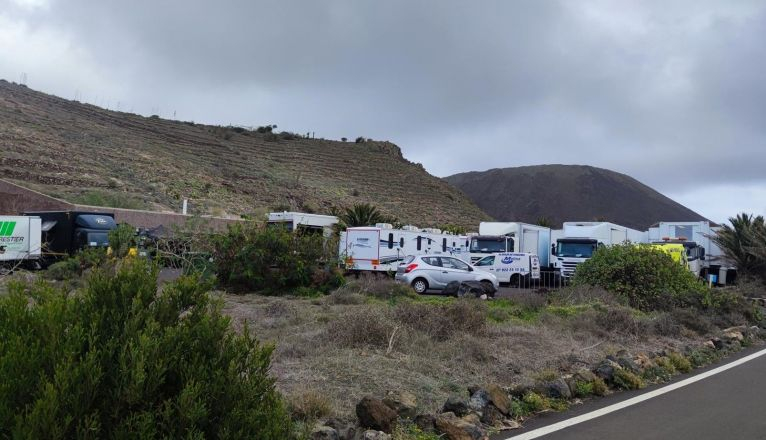
"The good thing about this industry is that it is very democratic, it distributes a lot of money and in a very short time the investment is very high", says Ismael. "You have to take into account that when a production arrives, workers from an infinite number of sectors are needed, such as make-up, electricians, cleaning, hotels, hardware stores, restaurants, transportation, and now with the covid protocols, daily PCRs are added."
From Lanzarote Film Commission, a film office created by the Sociedad de Promoción Exterior de Lanzarote SPEL, they are in charge of advising the different production companies that arrive on the island free of charge, whether on locations, permits or materials, among others, to optimize their resources and procedures.
Canary Islands is the most competitive European destination
The archipelago has managed to make a name for itself in the European scene thanks to its mild climates, its clear and clear skies and the scarce rainfall. This translates into more than 3,000 hours of sunshine per year, positioning the Canary Islands as one of the places in the world with the most hours of light.
In addition, the islands and, specifically Lanzarote, offer very varied landscapes, with paradisiacal beaches of white sand and black sand, volcanoes, lunar landscapes, cliffs and fishing villages that seem taken from fairy tales.
Air connections also play an important role, since there are numerous flights that connect the archipelago with Madrid in just over two hours, as well as direct international flights to major European cities.
Lanzarote Film Commission also takes part in this aspect, since under the umbrella of the Canarian Film Commission, they attend different film festivals, such as Cannes or San Sebastián, to make contacts, as well as different fairs where they promote the Canary Islands as the perfect destination to host international shoots.
After a request from the Spain Film Commission, the State established incentives that have risen up to two times, the last after the outbreak of the pandemic.
Currently, the deductions in the Corporate Tax are 30% for international productions that invest one million euros in Spain; that is, for every million spent, 30% of the amount would be returned. For those productions that invest more than one million, a deduction of 25% will be made, always with a limit of 10 million euros.
However, as the Canary Islands is an outermost region, 20 more points are added, that is, they generate a 50% economic return with respect to the first million euros, and 45% from there, with a limit of 10 million return, positioning the islands as a much more competitive environment than the rest of the peninsula.
As for Spanish productions, these have the same percentages and limits as foreign productions, but must have the Canarian Certificate of Audiovisual Production, issued by the culture area of the Government of the Canary Islands, as well as the certificates of nationality and Spanish culture of the Institute of Cinematography and Audiovisual Arts (ICAA).
"The State realized that the incentives provide a real benefit to the country, as they leave a lot of money," explains the technician of Lanzarote Film Commission. "This has placed us among the highest positions in Europe in terms of tax incentives, making us known worldwide."
The Government of the Canary Islands has also imposed economic incentives such as, for example, the elimination of the IGIC for film productions that are registered in the Register of Film and Audiovisual Companies of the Ministry of Education, Culture and Sports and meet a series of requirements.
The biggest obstacles: English and permits
Although the islands have many advantages, Ismael insists that not everything is a bed of roses, as Lanzarote has several pending tasks.
One of them is the issue of language. Most productions communicate in English, which can be a major language barrier when managing certain procedures on their own.
"We are not as prepared as we need to be in the institutions in terms of languages," reflects Ismael. "That's where the Film Commission plays a very important role."
On the other hand, there is the great problem of permits, a process that is complicated in Lanzarote, since it has a 41.5% of protected space.

Many spaces belong to the Government of the Canary Islands, but due to the location it is likely that permits are also needed from the Cabildo, the town hall and even from the coast. Many consultations and reports are required, which considerably slows down the process.
"In New York or Madrid you have all the permits ready to shoot in an hour, while in Lanzarote the process is very slow", explains the technician. "Think that to record in a specific place you can need up to four different permits".
However, from Lanzarote Film Commission they are confident that more productions will arrive on the island every year, as long as the Government maintains the tax incentives.
In addition, they insist on the need to create more specialized training courses related to sectors in high demand in films and series, such as make-up and wardrobe courses or electricians.
"When this demand arrives, you require agility and personnel capable of providing service," he says. "From the commission we do specialized training courses, but the need is so great that it would be very helpful if other institutions would bet on them."

Add La Voz de Lanzarote as a preferred Google source.
Stay informed with the latest current news.