
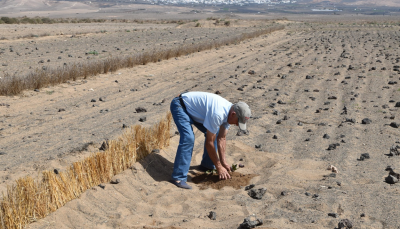
The Ministry of Agriculture, Livestock, Fisheries and Food Sovereignty of the Government of the Canary Islands announced yesterday in a parliamentary session that in 2025 it will enable, for the second consecutive year, a direct subsidy of an exceptional nature charged to its own funds to compensate for the effects of the drought in the agricultural sector.
The subsidy will have a financial allocation of around four million euros and, according to forecasts, will benefit around 3,000 producers.
This line of support gives continuity to the aid for the 2023 campaign of 3.87 million euros granted at the beginning of the year to more than 1,500 holders of potato, vine, olive, forage, sweet potato and temperate fruit farms to compensate for the economic losses suffered in the context of water scarcity that has reduced the yield of strategic crops for the local economy and food security.
As explained by the area's councillor, Narvay Quintero, "it is essential to maintain this line of aid to guarantee the recovery of the sector for future campaigns, as it provides direct economic support that allows farmers to continue with their activity while reducing its socio-economic impact on the rural areas of the archipelago".
"This is an immediate impact measure to combat water scarcity, but we are also carrying out long-lasting actions such as the installation of seawater desalination plants for agricultural use or improvements to networks and hydraulic infrastructures that will allow us to face the trend of rainfall deficit in recent years," he added.
In this regard, the head of the department highlighted the investment of 13.4 million, charged to the remnants of the Rural Development Programme (RDP) and own funds to acquire ten new desalination plants for agricultural irrigation through an order to the Canary Islands Technological Institute (ITC) and subsidies to the Cabildos.
In total, these new facilities will provide the archipelago with a total desalination capacity of 22,600 cubic metres per day, which translates into 8.24 million additional cubic metres per year to combat drought in the agricultural sector.


