
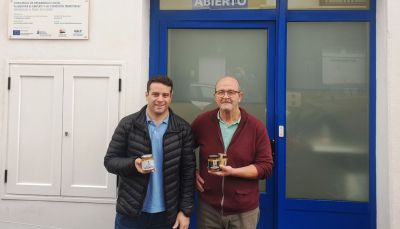
More than 50 years have passed since the golden age of fish canning production in Lanzarote, but Conservas Toledo has set out to revive the activity from a more artisanal perspective, in which tradition and innovation coexist.
Francisco Javier Toledo and Luis Toledo, father and son, started the journey of Conservas Toledo, a traditional canning company in the center of Arrecife, with the dream of bringing family recipes to the island's tables, embarking on a business based on their shared love for the sea.
Luis Toledo explains that: "My father always had in mind to create a cannery after all the ones in Lanzarote disappeared." With this starting point, they devised "to put the gourmet product in a glass jar, since it was always done in aluminum cans." Something unusual in the islands, but very widespread in the northern peninsula. To do this, they took as inspiration the recipes of his grandfather, who was a fisherman. "He liked to go to the dock, buy a tuna and make the belly in oil, but he didn't preserve them. From there came the idea of rescuing the canneries again."
"When the fishing agreement in the Saharan Bank was suppressed, fishing in the Canary Islands practically disappeared. Only the tuna boats remained." At the time they decided to set up the company, "we applied for a subsidy from Property 4 of Europe, on fishing, they helped us and here we are."
The dream begins to take shape
Although the ideas began to flourish since 2017 and the aid was granted in 2019, the pandemic stood in the way of the birth of the business. "In 2020 we started to develop the product," says Francisco Javier Toledo, although they decided to wait to start distributing the product given the prevailing uncertainty.
Already in 2021 they started selling their canned products. "It is very difficult to market your product coming out of a crisis," they say.
When they started to launch their canned brand, they tested themselves how to do the pasteurization and sterilization processes. "Everything was at home, we tried to make my grandfather's recipes and put them in glass jars. It was delicious. Everyone liked it, and we launched ourselves."
They also had the advice of a health technician, a biologist who explained the health guidelines they should follow to set up a cannery. "As a result of that, we ordered the machines we needed. We want to do it in the most artisanal way possible, but complying with all the sanitary measures," adds Luis Toledo.
Despite the initial difficulties, the acceptance of the product has been very good. In Lanzarote you have several points of sale such as in the cannery itself, Canary Meat, Roper and other gourmet and specialized stores on the island.
"Now with the website we also do online sales, which is having quite an acceptance." In addition, they plan to expand their business to the peninsula, where they are talking to be part of a project in which they would have a point of sale in Madrid, to market it to different points of the Spanish geography.
"We have the quality, what happens is that you have to consolidate as a brand, that people know you, especially a lot of marketing. It's difficult, but it's going well," says Francisco Javier.
The conservation process
Regarding the conservation process, Luis Toledo explains that "the preserve is a recipe that is cooked with water, salt and spices, as traditional as possible". With different types of cooking, for the different parts, "the loins, the bellies and the crumbs are made. The loins and the bellies are made separately, and the crumbs are the pieces of bellies that are not presentable in a jar. The noble parts of the tuna, which are usually the fins, the cheeks, the morrillo, all that is mixed in the jar of crumbs," adds Toledo.
Once the container is full, "the oil is put in, a little hot and the jar is closed. All this is by hand, it is very rudimentary. After filling it is passed to the autoclave and it alone does the sterilization process."
The final product is macerated for a while and then put on sale, "because the longer it is in the jar, the better the tuna is, because it matures with the oil." Thus, the preserve would be ready to consume and preservable for 5 years.
Francisco Javier Toledo stresses that the main thing about preservation is: "removing the air from the jar, sterilization and oil. That is what makes the product preserved inside the jar. Mainly sterilization. Achieving the product is quite expensive, due to the European food regulations," says Francisco Javier Toledo.
The essence of the product are the different types of tuna that pass through the sea of the Canary Islands and that are fished with a rod by fishermen from the islands, from whom Conservas Toledo buys the raw material. They affirm that their maxim is "to work with products from here and fresh." The best-selling product is tuna, which "is super juicy and very soft," says Luis Toledo. "The tuna crumbs are sweeping in Madrid," particularly in the Casa de Canarias, he adds.
A very selective distribution
Despite having limited productions because they depend on the quota collected in each season, which is a very variable factor, the company already distributes its products in the other islands and in points of the peninsula, such as Madrid, although they are aware that they still need a greater consolidation as a company to reach more places.
Conservas Toledo has also participated in prestigious gastronomic events such as Saborea Lanzarote or Madrid Gourmet.
To carry out this project they have had funds from the Local Development Strategy "Increase employment and territorial cohesion", having obtained through this way 64.218,61€.
In addition, they have received advice from the Chamber of Commerce of Lanzarote and La Graciosa, mainly in issues related to marketing and the digital presence of the company.


