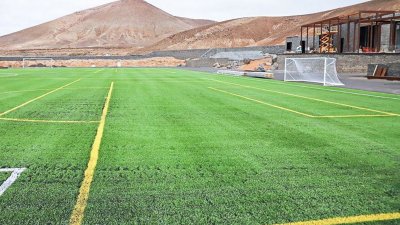
Every week the same scene repeats itself: Adú, 12 years old, ties his boots, trains like any other in his football club in northern Tenerife, but when Sunday arrives, he stays in the stands, because they don't let him play. It's true that it happens to other children on his team, but only to the Africans.
Adú has already opted to stay home on match days, because going to see his teammates play while he cannot is already too painful. All of this, due to a FIFA regulation which in its day was conceived to protect children from the abuses of certain professional clubs, but which does not fit with the reality of minors who have arrived in Spain by dugout canoe.
This is what Ana and Eduardo, the foster family in the Canary Islands of 'Adú', a Cameroonian boy whose real name they prefer to preserve, tell EFE. This couple from Tenerife has been trying since September of last year for the child's file to be accepted, and explaining to him and his companions why he cannot play is the most difficult thing.
It's not enough to say that it's a problem of paperwork or international regulations, because for a child, and for those who see him train every day, the explanation ends up seeming different: the regulations primarily impact African minors in foster care or under the guardianship of the public administration.
A letter to the "gentlemen of FIFA"
Tired of not being able to play, Adú has sent a letter to FIFA, similar to the one another child, Souleymane, sent already three years ago and that at the time unlocked the situation for hundreds of kids.
"To the gentlemen of FIFA: Hello, I am a 12-year-old African boy. I have been with my new foster family for two years. I am very happy at home, with my friends and my school. I really like football, I don't miss any training but because I am from another country they don't let me play," the child expresses.
"I don't want to go see my teammates because I get sad, I get disheartened, and I prefer to stay home. Everyone asks me when I'll be able to play and I don't know, and nobody knows. I just want to play and have fun like the other children," concludes Adú.
Despite the problem seeming to have been resolved in 2023, dozens of minors under the guardianship of the Canarian Government have once again found themselves at the same crossroads and the only solution FIFA gives to be able to play is to file an asylum petition, a situation that does not necessarily adapt to everyone's circumstances, which is why the process has become an endless chain of requirements.
Regulatory quagmire
Adú's foster family has submitted all the documents requested by the club and the Tenerife Federation, but each procedure usually leads to a new requirement that ends up clashing with FIFA's international regulations on the transfer of foreign minors, which blocks his registration.
This quagmire prevents in many cases foreign minors from obtaining a license if they do not meet certain administrative or residency requirements, even when it concerns children under the care of the administration and outside of professional football.
In the Canary Islands, clubs and families are forced to denounce once again that the regulation is being applied again to migrant minors who only want to play in neighborhood teams, something very different from the assumption that FIFA intended to regulate.
"In three years he has played three friendlies and will have trained about 250 times," summarizes Eduardo, his foster father, who adds that they have tried to get him to practice other sports, such as basketball or athletics. "But what he likes is football," he concludes.
Escape valve and path of social integration
This sport is for the child much more than a sports activity, it is "his escape valve", highlights Eduardo.
When he arrives home, if he has ten free minutes, he looks for a ball. If he cannot play, he watches football videos. And at school he takes advantage of breaks to play with his classmates", points out his Canarian family.
However, the weekend matches have become the most difficult moment. At first he would go to cheer on the team, but over time he has preferred not to go.
"He watches his teammates play, he always trains and cannot compete. In the end, he prefers to stay home and then ask for the result,” his family says.
The situation also does not go unnoticed by the rest of the team, who wishes to be able to see in the matches what Adú shows in training: a lot of speed, desire, and goals, which is why families, coaches, and teammates ask every week if he will be able to play: "The question every day is: do you have a license yet?".
The problem does not affect only Adú. In his club there are several more African minors in similar circumstances. For the teams it also generates difficulties, because they have children who train but cannot compete in the official leagues, and many times they end up bringing up youngsters from lower categories due to lack of players, an absurd situation.
They are not sports operations, but protected minors
The case reflects a paradox denounced by clubs and families, as the rule ends up affecting migrant minors who use football as a means of social integration, as recently defended by the Government of the Canary Islands, which asks that these children, many of them under its guardianship, be able to play on equal terms, understanding that these are not signings or sports operations, but protected minors.
While solutions are sought, Adú keeps doing the same thing every week, which is nothing other than putting on his boots and training with his friends, but his family already avoids making promises about when he will be able to play an official match.
"We don't want to tell him that next week he'll be able to play and then another three months pass," point out Eduardo and Ana, who admit that the child in all this time has given them "a lesson in frustration tolerance."
They do have very clear what will happen when that day arrives and Adú can debut in an official match as a forward for his club: "It will be a party and the result won't matter. The important thing will be that he can finally go out onto the field like any other child," they conclude.



Add La Voz de Lanzarote as a preferred Google source.
Stay informed with the latest current news.