
To Ramón Ramos Rodríguez, the three Rs of Arrecife.
Yesterday morning, on my way to work, after leaving the street dungeon of El Lomo that leads to El Charco, I found a still life in Jacinto Borges Díaz: the corpse of a pigeon crushed against the ground, an innocent victim of a hit-and-run, with its wings in a cross, its eyes blank and its chest open and reddish, like Christ wounded by Longinus' spear. As if an haruspex from ancient Etruria had torn out its entrails to foretell the future. The verses of T. S. Eliot in The Waste Land suddenly came to my mind:
April is the cruellest month, breeding
lilacs out of the dead land, mixing
memory and desire, stirring
dull roots with spring rain.
Winter kept us warm, covering
earth in forgetful snow, feeding
a little life with dried tubers.
It was a cloudy Tuesday, and around 10:35, when I had barely opened the green doors of La Madriguera, loaded the trunk with legs, the book jolatero and the school bench full of boxes of literary fruit, it began to drizzle. A chipichipi annoying enough to make me pick up the whole chiringuito and have to start cleaning again. The day before yesterday I had a very hard day. A pipe burst in the old Casona de don Pancho and part of the corridor that leads to the warehouse was flooded with liquid. Luckily the books were not damaged and the damage has already been repaired, but I spent half the afternoon and night scrubbing and bailing water. Just after writing a little poem about the Charco de San Ginés, I suffered in my own flesh the Charquerío de la Porlier, as if the verses, premonitory, that I composed, had exploded in my face.
I spent the rest of the morning shift appraising books, a very generous donation from the library purge of the IES Blas Cabrera Felipe, the oldest and best equipped center on the island, whose first headquarters was in Las Cuatro Esquinas, under the command of the royal commissioner Agustín Espinosa, whose Lancelotic imprint still persists. By the way, it would be Leandro Perdomo who would initiate, in Pronósticos, the campaign that finally materialized in 1970 to baptize the institute with its current name, in honor of the great conejero physicist, our most universal scientist.
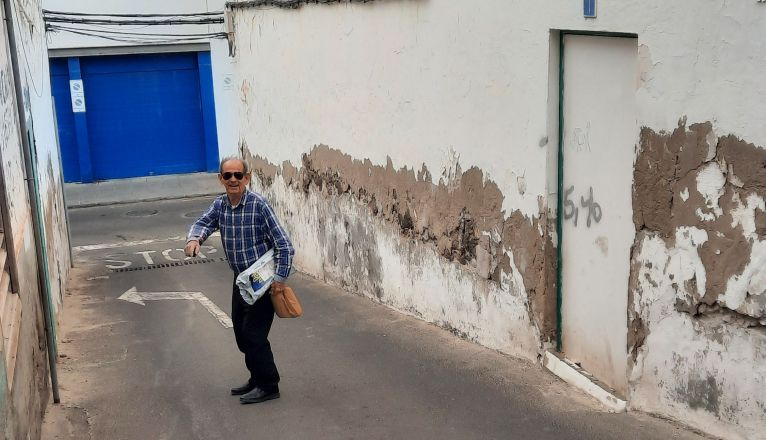
So after a rather difficult start to the week, I finally got my reward. It was on the way home, as is now customary. After closing the bookstore, I retraced my steps and as I was going up that narrow street, without a name (or at least without signs to indicate it, neither at the beginning nor at the end), halfway up the steep slope, I ran into an old man. I was wearing headphones, listening to rap at full volume and he was carrying several packages under his arm. But even so we greeted each other with a look and as I saw that he was about to speak to me, I turned off the music. "Some go up and others go down," he said to me. "Well, going down also has its thing, it's worse for the knees," I replied. And we started talking, as if nothing, as if we had known each other all our lives and I had met the neighbor. He told me that he had grown up on that street: El Callejón del Salto. I finally knew where I was walking every day, without having to ask or resort to Google Maps. That when he was a kid, it was paved with pebbles, not pitch. "And when was that?", I inquired, curious. "Well, imagine, if I'm 88 years old, I was born in '34, even before the Civil War." And he went on to tell me about the miseries of that fratricidal massacre and, above all, the hardships of the post-war period, which he suffered closely. The 5,000 soldiers who occupied Lanzarote after the Franco coup d'état. "There were almost more soldiers than civilians in Arrecife", that lapidary phrase stuck in my ribs like a shot. And the hunger and the ration cards, how the regime hoarded the food in large warehouses distributed around the island, distributing it in dribs and drabs through the fondas and ventitas, where families went for three hundred paupers grams of sugar or the equivalent cicatería that corresponded to them. The most absolute ruin. And then he told me about Melquíades' sale, in the same Callejón del Salto, in the first house that makes a corner on the right hand side from the bottom, turning towards the Charco. With each of his words, I felt transported to another era, with my guts rumbling at two in the afternoon, but abducted by the story. "Because Melquíades had a falúa with which he went fishing, some nights, while his wife stayed in the sale". And then they sold that fish that satiated so many mouths. "The house was inherited by a daughter and then her granddaughter, who died recently". And now it lies, like so many other mansions in Arrecife soaked in history, in the most complete abandonment. But that one, Melquíades', was not the only fish market in the capital. Before saying goodbye, Ramón, with his prehistoric mammoth memory, also told me that in the nearby La Palma street lived three sisters (I only retained the name of Eulogia) who had a little store each. That's what the capital of Lanzarote was like, almost a century ago. I am looking forward to meeting Don Ramón Ramos Rodríguez, the three Rs of Arrecife, again so that he can continue telling me the history of its streets.


Add La Voz de Lanzarote as a preferred Google source.
Stay informed with the latest current news.