
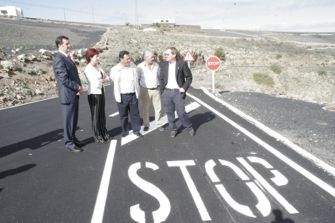
The island's road network officially premiered three new improvement works yesterday morning. The General Director of Infrastructure of the Government of the Canary Islands, Francisco González, traveled from Las Palmas to inaugurate the new works before the media. In his journey through half of the Island to publicize the modifications in three sections of the island's road network, González was accompanied by the president of the Cabildo of Lanzarote, Inés Rojas de León; and the Minister of Infrastructure and Public Works, Sergio Machín.
Three are the sections that have been conditioned and reformed to improve circulation. The first, which is part of the central axis that will unite Haría with Femés, runs between the capital of the northern municipality to the Mirador de los Helechos, thus completing the last of the sections of the axis that run through the north of the Island. For the completion of this line that will unite the north and south of the Island "only the seven kilometers of the La Geria road remain to be completed," said Sergio Machín. "With this road, a mid-mountain axis is consolidated, an alternative route to the major communications," said González.
Co-financed between the Cabildo and the Government of the Canary Islands
The works, as in the case of the rest of the mileage inaugurated yesterday, have been co-financed between the First Island Institution and the Government of the Canary Islands at 50 percent, as revealed by the Director of Infrastructure. Specifically, the paving and conditioning of the Haría road cost a total of just over 305,000 euros.
The reforms presented "are works on existing routes, and basically consist of pavement conditioning, signage, security measures," González pointed out. In this sense, in the case of the road in the northern municipality "the width of the platform has been respected."
Tiagua-Soo
After leaving the municipality of the thousand palm trees, the representatives of the Cabildo and the General Director traveled to the second section of the road network that was presented to society yesterday. This is the section that connects Tiagua with Soo, and whose works have already been completed several weeks ago, but were sponsored yesterday by González and Machín. The cost of these amounted to 375,000 euros.
Both works are part of the Road Network Conditioning Plan co-financed by the Cabildo and the Autonomous Community. According to González, in the year 2005 a budget of "close to one million euros" was allocated to this project, which, on the other hand, is valid until 2008.
The third section announced yesterday is the one that connects Uga and Femés, and is part of the central axis of the Network, so promoted by the island institutions. However, the work does not belong to the Conditioning Plan, since, as the head of Infrastructure of the Community pointed out, "it is an Improvement Plan aimed more at new construction, since it contemplates not only conditioning of existing platforms, but also requires small variants." In this sense, the work that connects the two towns of the municipality of Yaiza consists of the widening of the platform, "which had become very narrow." In addition, repaving, signage and security measures (the controversial guardrails) have also been contemplated in the reforms.
Transcendence
This is a "more ambitious Plan in the financial field." Its validity corresponds to the period 2001 - 2006. In the five years that the project has been implemented, "around four to five million euros" have reached the Island of the Volcanoes.
At the end of the visit, the president highlighted the importance of these works, "since they will allow the people of Lanzarote and our thousands of visitors to travel more safely on our roads. In addition, they will serve to facilitate communications between the different nuclei of the Island."
For his part, Sergio Machín assured that "the Ministry of Public Works is working on the improvement of the entire road network of the Island, as demonstrated by the fact that, currently, the technicians of the Cabildo are preparing an inventory of sections that need urgent interventions. This is the first step of an ambitious project such as the Lanzarote Cabildo's Road Plan, which will include works worth 13 million euros."
The controversy of the new Guatiza - Mala road
The people of Lanzarote still remember the serious problems that occurred on the new road from Guatiza to Mala, which was inaugurated less than a year ago. With the torrential rains that fell on the municipality in the months of February and March, the new road was flooded by mud from the ravines due to the lack of an efficient canalization system. As explained at the time by the heads of the Cabildo and the Government of the Canary Islands, the possibility that so much water would fall on Lanzarote had not been taken into account. Yesterday González commented that a forecast of rain had been made "for the next 500 years", but as has been seen, the technicians did not count on climate change.
González confirmed that since then numerous improvements have been made to the route to prevent it from happening again. "Sections of ditch have been installed, and slopes are going to be stabilized on the bank of the road", in addition to the placement of walls. As for these last works, "the file is already in Madrid, and once it is approved, not before, we will proceed with the reforms."
Passage for livestock
On the other hand, the goat herders in the area have also been demanding for some time that a passage for livestock be enabled over the new road. It turns out that the road occupies the traditional passage of animals from the stables to the grazing area. In this sense, González assured that the project for the installation of the bridge has been planned for a year and a half, pending the resolution of some administrative loose ends. González said that "the bridge is prefabricated and will not take long to be put in place", once all the procedures have been completed. As it is a work of the Road Agreement, financed in large part by the central government, Madrid has to give the green light for the enabling of the passage. In any case, the general director ventured that the work will be ready in "a month or a month and a half".


