
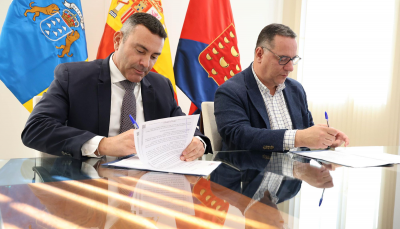
The Ministry of Education, Vocational Training, Physical Activity, and Sports of the Government of the Canary Islands, led by Poli Suárez, has planned a dozen actions for the island of Lanzarote within its Strategic Plan for Educational Infrastructures 2024-2035, including the creation of two new educational centers, a new location for a third, and the expansion of seven others.
This series of interventions, whose joint investment is around 60 million euros, of which seven have already been paid, represent, according to Suárez, "fulfilling the commitment we made as soon as we arrived at the Ministry and responds to the request made by the Cabildo."
Specifically, the new Secondary Education Institute (IES) in Playa Blanca is the work to which the largest investment will be allocated. With a budget exceeding 15 million euros, the launch of this new center will respond to the demand for schooling in the area, expanding the offer of Compulsory Secondary Education, Baccalaureate, and Vocational Training in a facility that will occupy an area of almost eight thousand square meters.
For its part, the project for the new Compulsory Education Center (CEO) in Costa Teguise, in the municipality of Teguise, already in the drafting phase and whose investment will exceed ten million euros, will create about thirty units for Infant, Primary, and Compulsory Secondary education, in addition to other spaces, such as a library, school garden, specific classrooms, and recreation areas or for sports practice.
Within the chapter of new constructions, the Infant and Primary Education Center (CEIP) Alcalde Alexis Tejera Lemes will be built in a new location. The project, currently in the drafting phase after the signing of a collaboration agreement with the San Bartolomé City Council, whose amount has already been paid, will have almost twenty new units, specific classrooms, a library, and common areas, as well as sports facilities and a school garden.
Expansions
The Strategic Plan for Educational Infrastructures 2024-2035 also includes the expansion of seven centers on the island. In the municipality of Yaiza, the CEIP Playa Blanca has been expanded with the annexation of an early childhood education school ceded by the city council.
In this same municipality, the expansion of the CEO Montaña Roja and the CEIP Uga is also planned, with the aim of responding to the existing demand for schooling in their respective areas, through the creation of different spaces and replacing several modular classrooms with definitive buildings. The planned budget in both actions is 4.5 million and 750,000 euros, respectively.
In Arrecife, the IES in Altavista and the CEIP Los Geranios will also be subject to expansion. In the first of these, with a budget of around 8.8 million euros, the construction of a new building has been planned to house new groups of Compulsory Secondary Education, Baccalaureate, Vocational Training cycles, as well as a new Enclave classroom for Transition to Adult Life. For its part, with an estimated investment of 1.7 million euros, the second contemplates the creation of new classrooms, the expansion of diners, a new library, and a room for teachers.
The Special Education Center (CEE) Nuestra Señora de los Volcanes, in Teguise, requires a greater number of spaces for group and specific classrooms, as well as a therapeutic pool and the replacement of modular classrooms. For this, the Plan foresees an expansion that will be around 6.5 million euros.
Finally, the CEIP Alcalde Rafael Cedrés, in Tías, will expand its facilities for a double purpose: to respond to the demand of its environment and, on the other hand, to reorganize the layout of the current spaces. This project, which amounts to more than 4.7 million euros, is currently in the drafting phase.
235 million
The Strategic Plan for Educational Infrastructures 2024-2035 is an initiative of the Ministry of Education of the Government of the Canary Islands, led by Poli Suárez, to meet the growing needs of the archipelago in this area.
With a budget of 235.5 million euros, it includes fifty actions, to which will be added the thirty already announced within the framework of the Shock Plan for the South of Tenerife, and its main objectives are the construction of new educational centers and the expansion of existing ones, especially in areas with greater schooling difficulties, which will facilitate the elimination
of modular classrooms.
The plan, which has been designed by the General Directorate of Infrastructure and Equipment of the Ministry of Education, coordinated by Iván G. Carro, is nevertheless dynamic and revisable, with annual updates that allow responding to social and demographic demands that may arise.
In addition, and unlike what happened with previous documents, its projects must have land for their execution and real financing (from the Government of the Canary Islands' own funds, agreements with other administrations, the Canary Islands Employment Plan, and EU funds), which will allow a greater degree of execution.
Finally, to facilitate the evolution and monitoring of the plan, not only by the Administration but by the entire citizenry, public schedules will be implemented on the Ministry's website, so that anyone can consult the situation of each file, whether it is new infrastructure, expanded centers, collaboration agreements, refurbishment of existing infrastructure, or new infrastructure with the provision of municipal buildings.
The Strategic Plan for Educational Infrastructures 2024-2035 thus responds to a series of principles: prioritization and equity; collaboration and coordination; community participation; transparency; updating and planning; and educational quality, in order to expand educational capacity, improve the quality of infrastructure, adapt the distribution of resources, promote inter-administrative cooperation, and carry out a continuous review of the plan to adjust and improve it in real-time according to the needs that may arise.


