
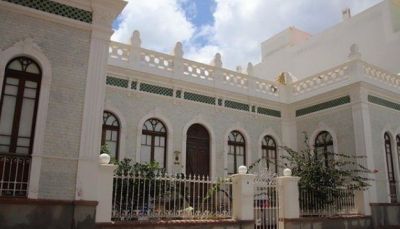
With more than three and a half million euros spent and nine years later, Casa Fermín, located on Fajardo Street in Arrecife, remains closed to the public.
This famous building was bought in 2013 by the previous president of the Cabildo, Pedro San Ginés, but remained closed when he left office in 2019, due to the defects presented by the property and the works it required. In addition, the current government group points out that the use that was announced in its day, as an archaeological museum, has no place in that place, among other things because the General Plan of Arrecife in force does not allow it.
Therefore, from the Cabildo they are still considering the different purposes that this house could have, while the rehabilitation works continue. Under the mandate of San Ginés only the lateral ships were restored, and it was shortly after the change of government when the works began in the front of the house. Three years later, those works are close to completion and could be completed next September.
However, the back would still have to be finished, an area that still does not have a drafted project and that would further increase the final cost.
The house "does not meet the conditions" to be an archaeological museum
Despite the fact that the purchase by the previous government group was made with the intention of housing the Archaeological Museum of Lanzarote, from the current Island Heritage Council insist that they do not even consider that possibility, since the building does not meet the optimal conditions for it and the current Arrecife General Plan does not allow that use.
“The house has very important patrimonial values and that is why we work to preserve it and put it to the use and enjoyment of citizens, but it is not the place for that museum”, says the Minister of Heritage, Ariagona González, who also adds that the restoration project “was a fix” by the former president.
In addition, González explains that Casa Fermín is too small to house all the archaeological materials, as well as being an inflexible space for the works.
“We need a versatile building, which allows us to play with the exhibitions, play with the heights. A heritage house does not allow us to do so, because it has a structure that must be preserved”, adds Ariagona González.
“Hidden vices” and rehabilitation in phases
Today the building is in the process of rehabilitation of the front, that is, the bulk of the house.
Although the work in this area was awarded for almost one million euros to the company Tragsa in 2018 by Pedro San Ginés, his government group never started the reform. This was launched at the end of 2019, with the new government.
In addition, from 2014 until the beginning of the current works there is no record of any investment in maintenance, so in that period dirt and deterioration accumulated year after year in the central part of the house.
The other big problem was the “hidden vices” found after the purchase of the house, which caused the budgets to increase, a direct consequence of not having carried out prior reports on the state and deterioration of the house before its acquisition.
This was already denounced in its day by the opposition, which also questioned that this building was bought from the family of San Ginés's partner.
"I am fully convinced that, with the perspective that distance gives, it will be considered one of the best decisions from the point of view of investment that the Cabildo has made", defended the president at that time.
However, the current Minister of Heritage insists that Pedro San Ginés “should not have bought it”, since “it was not the ideal time to do so, because we were in a very complicated crisis situation”.
The only thing that was opened to the public in the previous mandate were the lateral ships, but the minister explains that they are now closed because “it is not a place for traffic”, with the works in the rest of the house. In this regard, she points out that they have not suffered any deterioration since their closure.
In addition, Ariagona González recalls that, once the works on the bulk of the house are finished, the rear area would still have to be reformed, a part that not only faces the progressive deterioration of these nine years, but also adds the high cost of materials that they have to face now, due to the increase in inflation due to the invasion of Ukraine. Therefore, the budgets for the remaining area, the rear, could be much more expensive.
However, this last part still does not have a project drafted for its execution, although from the Cabildo they hope to have the building completely finished by 2023.
“We want to draft the project for the rear part this year and, once it is ready, execute the work”, explains Ariagona González. “Although this one we have to foresee depending on the completion of the main area that is being done now, but we hope that between the year 2022 and 2023 the whole house will be finished”.
“A sum and continues of public investment”
The current minister also questions that this project has become “a sum and continues of public investment” constant. In total, between the purchase (for 1,650,000 euros) and the drafting and execution of several projects, the Cabildo has already spent about 3.6 million euros.
The one that is being undertaken now in the front is budgeted at one million euros, of which 440,000 have already been disbursed. Likewise, the Minister of Heritage anticipates that the final investment of Casa Fermín would be further increased with the works of the rear, which still has no drafted project or budget.
“What is missing is to fix a small part, but it is money after all”, says González. “We have to make those investments and recover the heritage, that is not discussed, but with long lights and long objectives”.
End of works in sight, but for what purpose?
One of the doubts surrounding the building right now is for what purpose it is being rehabilitated.
As of today, Casa Fermín has a residential use in the General Plan of Arrecife, since it was used as a dwelling, with the exception of the lateral ships that already had commercial use.
“The lateral ships could remain as temporary exhibition spaces, but the interior of the house must be very clear, so we are considering several options”, says the Minister of Heritage.
She also points out that the house could open even if the back is not finished, but insists that for this they will have to get Arrecife to authorize the change of use.
Ariagona González insists that this “has been an inherited problem”, so from the institution they want to take the necessary time to “value and give the best possible use” to this emblematic house of Arrecife, especially for the great investment that it carries behind it.
The Archaeological Museum, without location yet
For now, the pieces that would form the archaeological museum are in a provisional premises rented by the Cabildo, waiting to find a suitable alternative that allows them to house the works.
“We are looking at possible locations for the infrastructure, but before making a decision of that magnitude we want to be completely sure so as not to spend a lot of money”, says the Minister of Heritage of Cabildo.
“What we cannot do is buy or rehabilitate something that does not serve as a museum, so we are looking at all the options”, she adds.


