
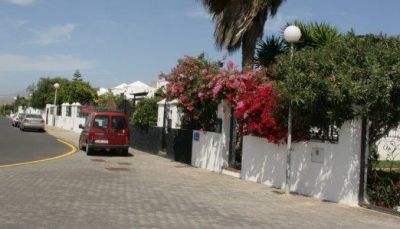
The Contentious-Administrative Court Number 2 of Las Palmas de Gran Canaria has confirmed another partial demolition order that has been in place for more than three years on one of the houses located on Chabusquillo street in La Bufona. The ruling, dated November 24, thus rejects the appeal filed by the owners of that chalet against the resolution issued in 2013 by the Agency for the Protection of the Urban and Natural Environment of the Government of the Canary Islands.
That same year, the Apmun ordered the partial demolition of another 13 homes located on the same street, after concluding that they had carried out illegal and unregulatable works, expanding the constructed area on protected rural land. The majority of the owners, including the island president of the PP, Ástrid Pérez, and the former coordinating prosecutor in Lanzarote, Miguel Pallarés, appealed that resolution in the courts, but, as this new ruling recalls, several appeals have already been rejected in the first instance, including the one presented by Pallarés.
In this new ruling, the appellants and owners of the house are José María García Betancort and Irene Ortiz Santana, to whom the ruling also imposes the payment of the costs generated by this appeal. In their case, the Apmun resolution ordered them to demolish all the works that were carried out to expand the house, including the construction of a swimming pool, an "attached building bordering one level of height", the extension of the house in an area of "9.25 square meters and about 3.5 meters high" and the "paving of the backyard in about 85.5 square meters, in addition to the perimeter enclosure of the land of about 37 meters." However, the ruling is not yet final, since an appeal can still be filed against it, as is the case with the rest of the judgments that have been handed down so far on other homes that are in the same situation.
"Neither does any term apply nor is the classification of the land the one claimed by the appellant"
In their appeal, the owners of the house tried to argue that the works were not carried out on specially protected rural land, but on the "maximum land delimited for population centers." And therefore, they argued that when the Apmun resolution arrived, the four-year period provided for in that type of land for "the exercise of the powers of protection of legality and restoration of the disturbed legal order" had already elapsed. However, reproducing the arguments expressed in a previous ruling on another of the houses on this same street, the judge concludes that "neither is the classification of the land the one claimed by the appellant", "nor does any time limit apply" for the exercise of those powers of the Apmun, among other things because it is protected rural land.
Contrary to what the owners claimed, the ruling states that "no collision occurs" between the Island Plan and the Arrecife General Plan regarding the classification of that land. Thus, although the appellants provided a report from a technician of the Cabildo stating that "the houses are located according to the Island Plan within the Maximum Land delimited for urban population centers", the judge emphasizes that the same report "indicates below" that within that type of land, "the distribution corresponds to the municipal planning", which in fact classifies it as rural and an area of ecological value - the jable.
The administration can act "regardless of the criminal procedure"
Regarding another of the arguments of the appellants, who tried to stop this procedure alleging that there was "criminal prejudice", due to the case in which the promoters of the urbanization were tried for crimes against the territory, the judge makes it clear that he "does not share" that criterion. And he emphasizes that "we are not facing a sanctioning procedure where the actors could be punished both administratively and criminally, nor are subjective aspects discussed about who has been the offender."
In this case, the judge points out that "the restoration of the altered urban reality constitutes a specific competence of administrative law, regardless of what the criminal procedure may declare, in the aspect of imputing the commission of a crime to certain people." That is, the administration can continue to exercise its powers to act against urban infractions, beyond the responsibilities that are then resolved in the criminal proceedings.
It should be remembered that this criminal route has already been resolved in the first instance, with the trial in which two of the promoters of that urbanization, the architect Federico Echevarría and the builder Antonio Caro, were sentenced to six months in prison "less one day", to one year of disqualification and to pay a fine of 3,600, for a continued crime against land planning.
In addition, that ruling also ordered the partial demolition of 14 homes built in that partial plan, since it considered it proven that rural land of natural ecological value was occupied. During that trial, several buyers testified as witnesses, who acknowledged that when the houses had already been handed over to them, they continued to carry out works - in most cases carried out by the same promoters - among other things to build the swimming pools. In addition, none declared to have taken legal action against those promoters who sold them the chalets, and they also could not explain why the meters that appear in the Land Registry do not coincide with those that appear in the Cadastre.
Like the new ruling that has just been handed down in the contentious-administrative proceedings, that criminal ruling is also not final yet, so the demolition of the homes will continue to be delayed until all appeals are resolved. In the case of this latest ruling, it should be noted that the magistrate who has issued it, Juan Ignacio Moreno-Luque Casariego, is exercising on a commission of services as reinforcement in that Court, but has his place in the Superior Court of Justice of the Canary Islands, in the Contentious-Administrative Chamber.


