
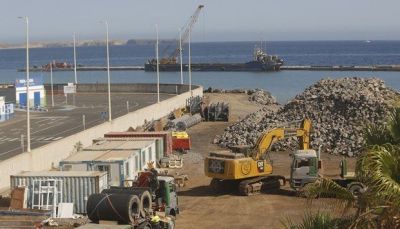
The Ministry of Public Works, Transport and Housing of the Government of the Canary Islands has announced that the expansion works of the port of Playa Blanca are entering a new phase in its construction once the concrete block dike, or second alignment, on which the new 440-meter-long outer dock will be built has been completed. This project, which was awarded at the end of 2017 for 39,330,000 euros, is financed by the Canary Islands Executive through the European Regional Development Fund (ERDF), and has an execution period of 48 months.
The Minister of Public Works, Sebastián Franquis, celebrated the "good pace" at which the works are progressing "of an essential work to promote the connectivity of residents and visitors of Lanzarote." "We must congratulate all those involved in this work for the good work they are doing that has allowed us to finish the concrete caisson dike even three months ahead of schedule," he said.
"However, we cannot be complacent and we must continue to advance all possible work because this type of port works are often affected by adverse weather conditions that can cause delays. In any case, we are on the right track to put this new port into operation by the end of 2021 and make a very important leap in the maritime communications of Lanzarote," he added.
52.3% of the budget of the work has already been executed
The UTE formed by the companies FCC-Mosquera and Carrasco Obras sank this Wednesday afternoon the last of the 13 reinforced concrete caissons that make up the new breakwater of the port expansion. In total, 16 concrete caissons of 33.6 meters long, 19.6 meters wide and a height between 15 and 17 meters have been built, which have been transported by sea from Arrecife to Playa Blanca, to create the dike (13 caissons) and an arm of another three caissons that will connect with the future interior dock of the new port.
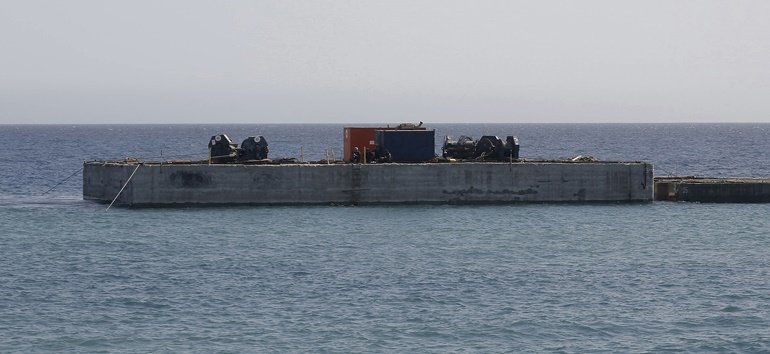
The completion of the dike is one of the "milestones" of this work that began at the end of 2017 and whose execution deadlines "are better than initially planned" according to the Government of the Canary Islands. In this sense, it is pointed out that in only 20 months -from December 2017 to August 2019-, 52.31% of the budget allocated to this work has already been executed, some 21.6 million euros. In addition, the filling works are already 70% executed. Thus, the regional Executive expects that by the end of this year, when the first 24 months of the work are completed, 26 million euros will have already been executed, so 14 million would remain for the years 2020 and 2021.
Once the breakwater dike is completed, the successful bidder UTE will continue working on the creation of the dock on this alignment, in addition to the fillings of the interior area and in completing the first alignment, that is, the 300-meter-long slope dike that connects the port expansion to land. This slope dike is formed by a rockfill that is still being completed with concrete blocks of 16 tons each.
Works that will double the surface area of the port
The Government of the Canary Islands recalls that, with the expansion works, the port of Playa Blanca will double its surface area, going from the current 91,470 square meters to the 205,569 square meters planned. The investment will be mainly allocated to the execution of an outer dock with capacity for two ferries, such as those currently operating, and with the possibility of additionally housing medium-sized cruise ships in the new 300-meter-long dike.
The port will also have a new maritime station, with a commercial area of 2,300 square meters, as well as new esplanades where more boarding and parking areas will be located. The existing dock will be used for fishing, recreational and sports boats, increasing its current capacity from 162 berths to about 210.
The one in Playa Blanca is one of the "most important" ports in terms of passenger volume of those that make up the network of the public company Puertos Canarios, since until July of this year more than 600,000 passengers, about 140,000 cars and motorcycles, and 27,000 industrial vehicles had passed through these facilities, according to the regional Executive.


