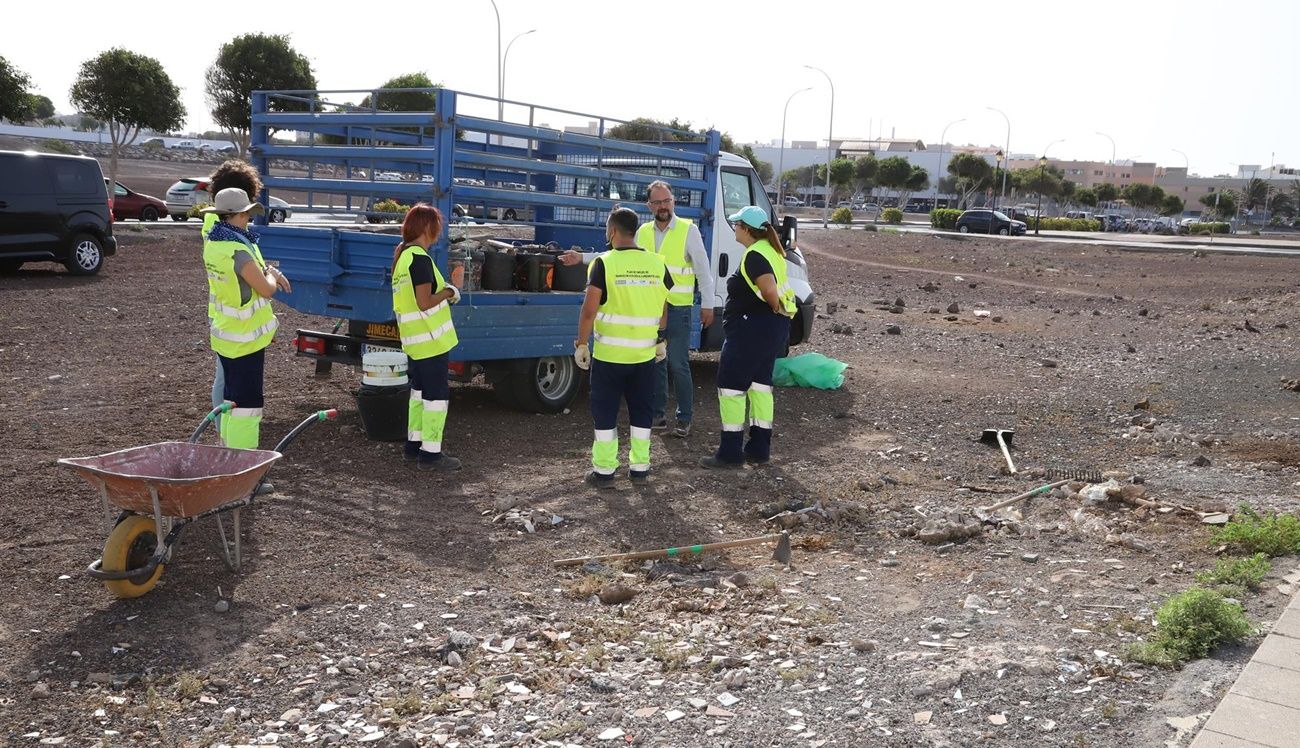
The workers hired by the Cabildo of Lanzarote through the Ecological Transition Employment Plan (PETE) 2021 have removed more than 530 tons of debris from different neighborhoods of Arrecife in the five months they have been working, according to reports from the Island Corporation.
Specifically, they point out that through this Employment Plan 54 people were hired for a period of 8 months to carry out tasks of conditioning, cleaning and maintenance of various urban and natural spaces on the island. "The staff is organized into six work teams, which have different objectives and areas of action, which were defined by the Cabildo, in collaboration with the town councils, at the beginning of the project," explains the Employment Councilor of the first Island Corporation, Jorge Peñas.
According to Peñas, one of the teams is acting mainly "in urban or suburban environments of Arrecife, where illegal dumps tend to form." "The hired workers separate the debris by type of material and deposit it in trays or sacks to then proceed to its removal with the collaboration of the Arrecife City Council," details Peñas.
"In these months they have acted on several rural roads of the capital, as well as in the neighborhoods of Argana, Maneje and San Francisco Javier, where they have removed more than 530 tons of debris and have received constant congratulations from the neighbors," highlights the councilor.
Cleaning of the coastline and urban and rural areas
From the Cabildo they explain that another of the teams is dedicated to cleaning the surroundings of the Zonzamas Environmental Complex, in order to "minimize the proliferation of plastics in the environment." In this case, Jorge Peñas points out that "more than 11 tons of plastics" have been collected.
The third of the teams is in charge of the recovery and cleaning of the island's coastline, having collected "an average of seven bags of garbage every day after having given the first complete tour of the coastal areas of Lanzarote." In addition, this group has also pruned exotic invasive species present in places such as the Barranco del Quíquere, in collaboration with the Early Warning Network of Invasive Exotic Species of the Government of the Canary Islands.
One of the teams that collaborates with the town councils more closely is the one dedicated to the improvement of the urban and rural cases of the island. "They have carried out actions in various municipalities, from a shock plan of cleaning in plots of Caleta de Famara to intervene in the maintenance of the palmera of the Casa Mayo Guerra of San Bartolomé," says the Employment Councilor of the Cabildo, who specifies that, during these months of work, "they have removed 400 cubic meters of pruning remains and waste in collaboration with the different municipalities of the island, which would be equivalent to more than 90 tons."
Conditioning of trails
The Cabildo of Lanzarote also points out that the cleaning and conditioning of ten trails of the island indicated by the Environment area of the island corporation is the main task of another group of workers who, until now, "has already acted on eight of the fixed trails mainly performing tasks of pruning dry vegetation or invasive species".
Finally, part of the workers is dedicated to the maintenance and conservation of agricultural varieties in ecological cultivation, operating in the Center of Agricultural Biodiversity of Lanzarote (CBAL).
"They have carried out pruning, irrigation and fertilization of up to 800 plant species between vines, prickly pears and other fruit trees; and have harvested almost 500 kilograms of onion and different native grains (beans, peas, beans, peas)," details Jorge Peñas, who is satisfied with the development of this Employment Plan, which has an investment of nearly one million euros and is co-financed by the Canarian Employment Service and the State Public Employment Service, charged to the Comprehensive Employment Plan of the Canary Islands.
During these months, the 54 people hired have also received training in occupational risk prevention and gender violence prevention, as well as in environmental awareness and social skills and conflict resolution.


Add La Voz de Lanzarote as a preferred Google source.
Stay informed with the latest current news.