
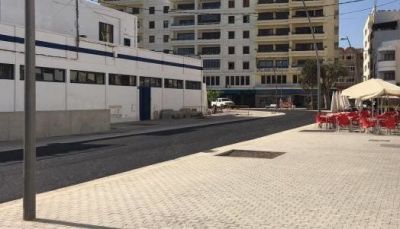
Although pedestrians have been able to walk through it since August 11, the work on the Avenida Marítima in Arrecife is not yet finished. The Cabildo, according to the Councillor for Commerce, Ariagona González, has explained that it plans to receive it "at the beginning of October", when Tragsa concludes the "details" and "small things" that are missing. Thus, the public company almost doubles the two-month period that was given to finish this work, which expired on July 25. Despite this, Ariagona González has defended the "excellent work" of Tragsa and believes that "it would not make sense" to apply sanctions for this delay.
"What mattered to the Cabildo is that the bulk of the work was finished, that it could be put to use, that pedestrians could walk through it, that the merchants would not be affected. And all that has been achieved. The little steps that are missing do not worry us too much in the sense that the Avenue is open and people can walk through it and the merchants are already fine", the councillor told La Voz. Thus, she believes that "in all works there are last-minute complications, which are gradually being solved", but that Tragsa "has done its job well".
"In two months it has put the Avenida de Arrecife, which was open in channel, has solved the problem we had, has hired a lot of staff, they have been working practically from 7 in the morning until 7 in the afternoon and the truth is that it is a pleasure that there are companies that do what they have to do, work and finish things as it should be, in the planned time", said González, who insisted that "although it is not received", the Avenue "can be used". For the moment, however, only pedestrians can use it and vehicles do not yet have access (not even those that would be authorised with the semi-pedestrianisation).
The "details" that are still pending are the "definitive connection" for the lampposts to start working, which González expects to be "this week or at the beginning of next week", to place the irrigation of a planter and a piece of pavement at the exit of Calle Real. This piece, she explained, has special characteristics because "it has to support the armoured truck that passes by there every day when leaving the banks and it also has to be a drain" that filters rainwater. According to her, this piece has been ordered and is being "manufactured".
"I don't think the EU funds have to be returned, but I can't guarantee it"
"I suppose they will enable it shortly for the semi-pedestrian traffic that was decided in the plenary session (of the Arrecife Town Hall) on Tuesday", said González, pointing out that this aspect corresponds to the Consistory. The councillor has stated that she does not know if the Town Hall "was waiting" to open it to taxis, buses and emergency vehicles until the motion proposing a popular consultation on what traffic will be allowed on the road was voted on.
Regarding this motion, which was approved and by which the citizens will decide how the traffic will be on the Avenue, González has assured that she is "in favour" of citizen participation, but has stressed that the project "had already been participated". She recalled that it was submitted to public consultation and that the "associations of that time" signed a document in which they stated that they were "in favour" of the project. "But it is good to ask again", added the councillor, who declares herself in favour of semi-pedestrianisation.
One of the points in dispute over traffic on this road was the requirement to reduce traffic included in European subsidies for open commercial areas. A few weeks ago, the possibility was even raised that, if traffic was maintained, these EU ERDF funds might have to be returned. "I don't think that would happen, but I can't guarantee it 100%", González said in this regard.
"The requirements are that public space for citizens must be increased. The pavements have to be wider, there have to be more squares, more free space, which is achieved in the project, because the pavement has increased, and there are also large squares that did not exist before; and there has to be a decrease in traffic. ¿Does the reduction in traffic have to be total? No, but there has to be", explained the councillor. González adds that with a semi-pedestrianisation and maintaining traffic in one direction, traffic is "reduced". Therefore, she believes that keeping it in two directions could pose some risk of having to return those funds.
The Cabildo has already had to return 470,000 euros to the EU
However, according to González, the Cabildo has already had to return money to the European Union for the delays in these works. It was about 110,000 euros that, according to her, the Corporation had to "certify" before December 31, 2015. But the delays prevented it. "The first 4 certifications have been paid with that money but the rest have not, because it was not finished on time due to the problems that we all know", she pointed out.
And to that amount we must add what had to be returned also for the delays in the project "De Plaza en Plaza" of the Villa de Teguise. In that case, the works were "delayed" because "archaeological remains" were found, González indicated. Thus, according to her, in total the Cabildo has returned 470,000 euros of the EU Funds it received for the works of open commercial areas.
At the same time, the Government of the Canary Islands has deposited "about 350,000" euros to the Cabildo. This amount corresponds to the "lot for Commerce in Lanzarote" and is destined to open commercial areas, either for "new construction" or for "commercial dynamisation". Of the amount contributed by the Government of the Canary Islands, which finances 50% of the work, 75% comes from the EU ERDF funds and the remaining 25% from the autonomous community itself. The other 50% of the work is financed with funds from the Cabildo of Lanzarote.


