
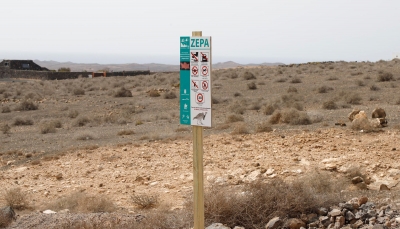
The Cabildo of Lanzarote continues these days to disseminate the seven Special Protection Areas for Birds (SPA) existing in Lanzarote and La Graciosa. The initiative is aimed at "strengthening the conservation and maintenance" of protected areas and promoting the preservation of the island's natural heritage.
These interventions range from social dissemination to the modernization of signage, through the control of human activity in these areas or the effective protection of native fauna and flora.
The Minister of Environment, Samuel Martín, has once again recalled the importance of "making it very clear what are the natural values that we must safeguard, and making it clear to the thousands of people who visit us annually," he notes.
Therefore, about the measures required to take into account when visiting the SPA areas. "Needless to say, the use of drones is strictly prohibited in these areas, where it is also not allowed to leave the trails or disturb the numerous specimens of birds that make up our rich natural heritage," the counselor clarified.
Likewise, as in other locations located in sensitive environments, the circulation of vehicles outside the tracks is strictly prohibited, with the maximum speed on these roads always limited to 30 kilometers per hour.
Seven havens of biodiversity
Lanzarote and La Graciosa include in their territory a total of seven Special Protection Areas for Birds (SPA), clearly delimited and subject in the field of their competences to "strict control" by the Institution. These areas are part of the Natura 2000 Network, whose objective is to guarantee the maintenance of the conservation status of natural habitats. The Natura 2000 Network is a coherent ecological network formed by Sites of Community Importance, Special Areas of Conservation and Special Protection Areas for Birds, and constitutes a fundamental instrument within the European policy on nature conservation.
One of these seven SPA spaces is the Northern Islets of Lanzarote and Famara. Here, the populations of seabirds, with seven species, and birds of prey, with six, stand out, as announced in the Natura 2000 Reference Portal of the Autonomous Community of the Canary Islands.
Another SPA is located in Los Ajaches, where the summits of the massif harbor a large part of the populations of common kestrel (Falco tinnunculus) and barn owl (Tyto alba), while on the slopes and lower parts of the mountainous area partridges (Alectoris barbara) and the Trumpeter Finch (Bucanetes githagineus) are abundant.
The belt of volcanic landscape around the Timanfaya National Park, La Geria, constitutes another haven of biodiversity that must be carefully protected. There we find, among many other species, reptiles such as the Haría Lizard (gallotia atlantica) and the Rough Perenquén (Tarentola angustimentalis). And with regard to birds, it is worth highlighting the presence of breeding colonies of the Cory's shearwater (Calonectris diomedea), as described by Natura 2000, the main European instrument for nature conservation on this continent.
On the other hand, the SPA of Llanos de la Mareta and Rubicón cliff is located in the municipality of Yaiza, and covers the so-called Llanos de La Mareta and a section of cliff coast in the Rubicón area. The place is an important area for steppe birds, and some colonies of seabirds are located on the coastline.
The Llanos de La Corona and Tegala Grande is another of these spaces full of biodiversity, located at the foot of the hills that descend from Las Nieves, and bounded to the west by the Guanapay mountain that separates it from the nucleus of Teguise; extending in a wide plain that penetrates the Famara massif through the Vega de San José.
The Timanfaya National Park, for its part, occupies approximately 28% of the 172 km2 that the surface of the lavas emitted during the six years that the volcanic activity of Timanfaya lasted. The life of Timanfaya is dominated by lichens (about 150 species) and invertebrates (about 120 species). There we find numerous seabirds such as the Cory's shearwater (Calonectris diomedea), the Bulwer's petrel (Bulweria bulwerii) and the Madeiran storm petrel (Oceanodroma castro), and also species of birds of prey such as the kestrel (Falco tinnunculus) or the Egyptian vulture or common alimoche (Neophron percnopterus) and passerines such as the subalpine warbler (Sylvia conspicilliata), the linnet (Carduelis cannabina) and others.
Finally, the Salinas de Janubio stand out for the importance of the ornithofauna in the area. There we observe a great diversity of species, as it is one of the most important locations in the Canary Islands for the stopover of aquatic birds, mainly waders, with about 35 species having been cited.


