
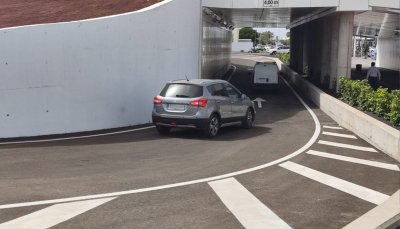
The Ministry of Public Works, Housing and Mobility of the Government of the Canary Islands, through the General Directorate of Road Infrastructure, directed by Rosana Melián, has opened the road of the new underpass of the LZ-2 in the town of Playa Honda to traffic.
Although the works were scheduled to last nine months, they were finally delayed almost two years. In addition, in statements to La Voz, Isidro Pérez, mayor of San Bartolomé, found it "illogical" that it was not opened to traffic when the technical review had already been carried out two weeks ago. Regarding the delay in its execution, Pérez explained that "there were technical problems such as the interior cladding that took time to arrive from Germany".
With the opening of the new transverse axis, the action that has created a new underpass under the LZ-2, parallel to the current one, and that since this Monday serves as communication between the residential area of Playa Honda and the industrial and commercial area located on the other side of the highway, is concluded. The new underpass has a design that facilitates both pedestrian and vehicular traffic, favoring road, pedestrian and bicycle communication.
The infrastructure has a pedestrian sidewalk of 5.50 meters wide, a segregated bike lane of 3.50 meters, a landscaped strip of 1.90 meters and a traffic lane for vehicles of 5.50 meters, guaranteeing safe coexistence between the different modes of transport. In addition, it incorporates six skylights on the roof that provide natural lighting, improving the experience of those who travel through it.
A "unique" work in the Canary Islands
From Public Works they assure that "this project stands out not only for its benefits in mobility, but also for the innovative construction procedure used, which makes it a unique work in the archipelago".
The two central boxes that make up the underpass were built on the margins of the road and subsequently pushed to their final position, under the LZ-2, by means of a high-precision operation.
The structure was moved slowly at a speed of 1 to 2 meters per hour, using a battery of hydraulic jacks that allowed the structure to be taken to its final position, under the LZ-2. This method, common in railway works but unusual in road works, has been used for the first time in the Canary Islands and has required the participation of international companies specialized in this type of operations.
The mouths of the underpass were executed "in situ" on the margins of the road once the boxes were placed, completing a work that minimized the times of affectation to the traffic of the LZ-2 and provided a cutting-edge technical solution.
The works, awarded to the company Señalizaciones Villar S.A. for 3.8 million euros, will allow to divert around 9,000 vehicles per day from the roundabouts of access to Playa Honda, significantly reducing congestion in one of the busiest points of the island. With this action, currently saturated spaces are regenerated, sustainable mobility is promoted and pedestrian traffic to areas of great activity such as supermarkets and shops is facilitated, thus consolidating a more efficient and safe connection between the residential and industrial-commercial area of Playa Honda.
Add La Voz de Lanzarote as a preferred Google source.
Stay informed with the latest current news.


