
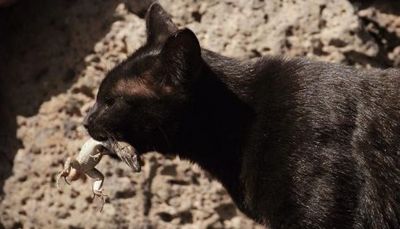
A total of fourteen associations and research groups have proposed to the Teguise City Council the creation of a specific group of the Local Police to control the feline population. They state that "there is an overpopulation of cats in the natural environment and outside private homes, which is causing great damage to native and/or endemic fauna."
The signatories include the Association for the Conservation of Canarian Biodiversity (ACBC), the Ornithology and Natural History Group of the Canary Islands (GOHNIC), the Wildlife Rehabilitation Group of Native Fauna and its Habitat (GREFA), the Telesforo Bravo-Juan Coello Canarian Foundation, the Herpetological Association Timon, different researchers from the Higher Council for Scientific Research (CSIC), and graduates in the field of biology and biodiversity conservation.
In their writing, the fourteen signatories propose to the animal ownership area of Teguise different suggestions aimed at modifying the municipal ordinance regulating the ownership and protection of animals, as well as the collection and stay of animals in municipal facilities, after the City Council opened a period of citizen participation that ended on November 30.
These associations and research groups mention the report "Environmental impacts and risks to public health of cats (Felis catus) in the Canary Islands: Proposals for coherent management" published by the ACBC and point out, as main causes of feline overpopulation, "the irresponsibility of some owners who let their cat out of the home without any type of control and surveillance" and "the feeding of feral cats by some residents of the municipality in unauthorized areas that constitute natural habitats for protected and threatened wildlife and without having a license for said activity, with authorized feeding points already existing."
Campaign to capture and put feral cats up for adoption
In addition, the signatories warn of "the need for greater investment in mass sterilization campaigns for abandoned cat colonies, also reducing the cost of sterilization for private cats, and relocating colonies near protected spaces or areas with the presence of vulnerable native species." Therefore, they request to initiate a campaign to capture and put up for adoption feral cats found in these natural spaces. They consider that La Graciosa deserves special attention, "due to the importance of the island for the nesting of different species of seabirds of great interest that are preyed upon by cats."
"It is important for citizens to become aware that cats that are allowed to leave their homes and roam freely, together with abandoned unsterilized cats, generate a large number of unwanted litters with several kittens, exacerbating this problem. They can also cause annoyance to some residents of the municipality due to hygienic-sanitary issues, since there are people allergic to these animals, also being a potential risk for road safety," they point out.
In order to carry out effective control of the measures proposed in the presented document, the signatories assure that it is necessary to create a specific group of the Local Police of Teguise "that makes periodic visits to homes, verifying that both cats and dogs carry the identification chip, something that the current ordinance already requires." "In this way, a complete municipal census of companion animals can be obtained, being able to capture those that are outside any home, proceeding to their identification and issuing the corresponding sanction to the owner," they add.
On the other hand, they point out that "it must be taken into account that there are different levels of protection (international, European, national and regional) for the wild species of Lanzarote and La Graciosa." "Many of these species are listed as vulnerable or in danger of extinction at the National and/or Regional level. This is demonstrated by Royal Decree 139/2011, of February 4, for the development of the List of Wild Species under Special Protection Regime and the Spanish Catalog of Threatened Species and LAW 4/2010, of June 4, of the Canary Islands Catalog of Protected Species. Therefore, all this regulation must be taken into account when making modifications to the future animal welfare ordinance of the municipality of Teguise, as well as by the citizens of the municipality," they state.
Finally, the associations and research groups point out that "the problem of cats and the conservation of wildlife must be treated at the island level, bringing together all the municipalities of the island and the Cabildo of Lanzarote to design a network of joint action and collaboration."
Add La Voz de Lanzarote as a preferred Google source.
Stay informed with the latest current news.


