Technological advancement has arrived years ago quickly and almost without us realizing it into our lives. This has brought about positive changes in society, but also negative ones. Some examples of this are job losses in some supermarkets due to self-checkout machines or the use of artificial intelligence to carry out many tasks.
The latter is causing some inconveniences in certain professions such as in the world of graphic design, which are facing a tool that can carry out similar creative work. Of course, with some errors. According to a UGT report published at the beginning of this year 2026, 50% of large Spanish companies use artificial intelligence, while in small companies it is 21%.
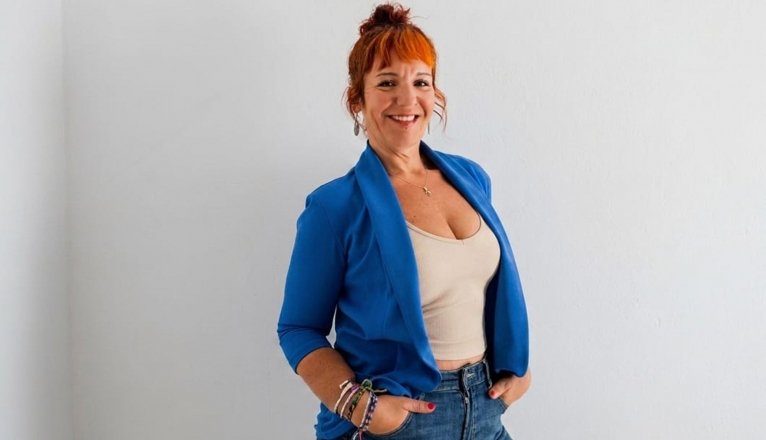
Elisa Betancor, a graphic designer from Lanzarote and owner of a company in this field, tells La Voz that she has noticed a decrease in orders for poster designs, although in the case of logos there is still a high demand. In the case of the professional, most of her clientele are public institutions, but even so, she has noticed the impact of AI.
"Since last year I have noticed that demand has decreased, but I notice that it is private clients who are doing their own designs the most," she points out.
The use of artificial intelligence causes the designs created with it to have practically identical characteristics. This happens due to the programming of this tool, which is designed in a specific way, so the designs end up having very similar traits and no personality.
Here comes into play the contribution of humanity and creativity that each graphic designer brings to a work, something that artificial intelligence is impossible to copy and capture.
AI, a support tool
Although artificial intelligence harms work in some areas, it can be a great support tool for optimizing time or polishing details more quickly.
"As a tool, it works in terms of speed because sometimes clients need the work right away, although you do have to specify the prompts (detailed explanations) to the AI very well and have time to do them," says Betancor.
However, the graphic designer opposes the use of AI as a "final performer" of works, although "it serves as a tool." For example, in a design, it can be useful to add a hat to the image, which would take much longer to do using an editor due to measurements and other factors. "I ask it for an element, not the entire work," she continues.
Artificial intelligence, Betancor opines, "helps me connect with the client and go directly to the design they want, thus saving me from making many sketches."
Adding value to a company's brand
The designs created by artificial intelligence are, at first glance, very recognizable due to the inherent characteristics of this tool thanks to its programming. These works tend to have a very similar style and a lack of uniqueness and differentiation compared to other posters or logos.
"If you have a brand, try to have values in that design too... they all do the same thing, it doesn't matter if it's a law firm or a pizzeria, they all have the same image," she states.
In the case of posters, many of which we see disseminated and can tell are created with artificial intelligence, the graphic designer has less and less power in them. "I understand that with the immediacy of social media, many people won't pay money for it because maybe this poster will disappear in a day, but a logo or a book cover cannot be made by AI," she assures.
And, as the professional points out, artificial intelligence "can help the designer be creative because you don't always have it, as emotions influence it, but having it do it for you, no." "I'm not going to sell you an AI-made logo because in the end it's devaluing myself," she indicates.
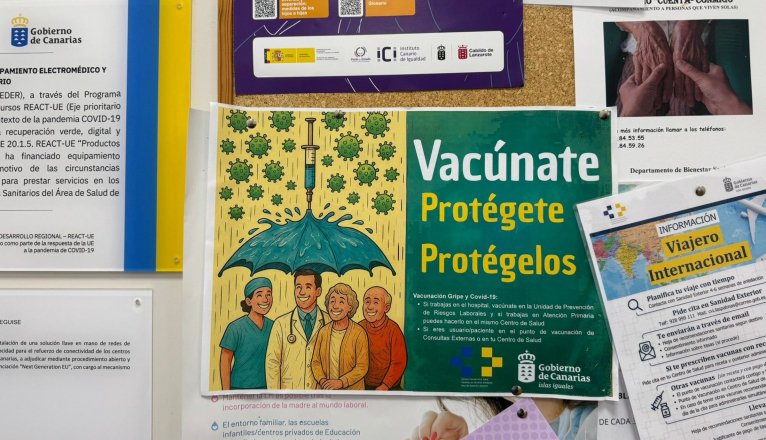
The use of intelligence is not only linked to companies or private clients, but public institutions also use it in some of their campaigns. This is the case of a poster about vaccination seen in a health center in Lanzarote, where it can be seen that it is entirely made with this tool.
That a public administration, with the great resources it has, uses AI to create posters and does not do them through a graphic designer is something that is surprising. In this poster, this tool is especially noticeable in the drawings. "With a graphic designer, normally less is more, and with AI, more is more," explains Elisa Betancor. "Many times, people want to put everything on a poster, but if you overload it, they won't read it," she says.
Work behind graphic design that is not seen
When thinking about the work a graphic designer does, we might imagine that when creating a piece, they do it quickly, envisioning an idea and bringing it to life. However, it takes much longer than it seems and there is more analysis behind it than one might believe.
The graphic designer explains that, in the case of a brand logo, the work focuses on conducting a market study and analyzing the values, the objective, and the competition, which takes a specific amount of time. For this, she dedicates up to three days from when she starts working on it.



Add La Voz de Lanzarote as a preferred Google source.
Stay informed with the latest current news.