
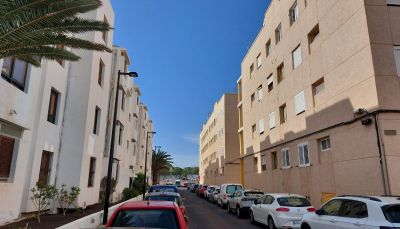
The Local Committee of Nueva Canarias (NC) in the municipality of Arrecife encourages the conservative government group of the Popular Party (PP) and Coalición Canaria (CC) to "transform the current urban model" that prevails in the neighborhoods of the capital. A model, they say, “that distances the neighbor from neighborhood coexistence, puts the vehicle as the protagonist of the city and does not adapt to the new climatologies.”
For the spokesperson of NC in Arrecife, Sheila Guillén, “the prevailing model in the neighborhoods of Arrecife is called “indolent”, that is, "it does not take into account the people who reside in them or their needs for community interaction", and configures "an exclusive public space for private activities and the car”, she stressed.
Thus, for the Canaristas it is necessary, in the first place, a "small-scale transformation of certain areas of the neighborhoods", starting with actions of “tactical urbanism” that redesign the aesthetics of the environment, facilitate the meeting of neighbors and improve their quality of life. This type of urbanism, they comment, “is a form of simple urban transformation that allows us to change the use we make of certain underused, abandoned spaces or that we do not consider at first glance to be worthwhile, into affordable, agile, participatory and adaptable spaces.”
They continue alluding to the fact that this “tactical urbanism” is "ideal" since "it does not involve large works or budgetary amounts, allows alternative uses of public space and offers opportunities to adapt to the needs of residents and climate change." “They have already been carried out in capitals such as Las Palmas de Gran Canaria and La Laguna near schools and kindergartens with the aim of promoting active, sustainable and healthy travel,” says Guillén.
“The neighborhoods of Arrecife need to improve in aesthetics, in social infrastructures and in the use we give to public space. We must change the look of what a neighborhood and a city means, which is not simply an environment of homes and roads, but of coexistence, of ties and community,” says Guillén, who is convinced that “neighborhoods are becoming increasingly important in people's lives, since they are the closest environments, where the growth of the capital is projected in the medium and long term, and where the greatest neighborhood activity is generated.”
Therefore, from NC they urge that "each municipal action that is implemented in the neighborhoods be aimed at transforming them into eco-neighborhoods, more sustainable, participatory and adapted to climate change." They give as an example in this line to review the "type of asphalt that is used for the streets, the trees in the parks and avenues, the model of playgrounds or the channeling of rainwater."
“It is not difficult to imagine that a street like Tajaraste in Argana Alta can be transformed into a space where vehicles travel at certain times, for example, in the middle of the morning, and early in the morning and in the afternoon it is pedestrianized, with play and shade areas, accessible to cafes and shops and diaphanous to the playground,” says Sheila Guillén, who “imagines areas of this type in all the neighborhoods of Arrecife that reverse the pessimism and lack of incentives for residents to use their urban space more and better.”
According to the party spokesperson, they concluded, “may no one take away our illusion and hope of having a different Arrecife, friendly to our environment and that takes care of the residents of all generations.”


