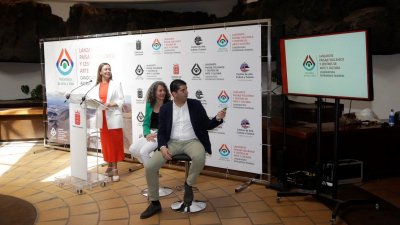
The Lanzarote Cabildo is advancing the island's candidacy as a World Heritage Site by Unesco. The president of the highest island body, and leader of the Art, Culture and Tourism Centers, María Dolores Corujo, and the CEO of the centers, Benjamín Perdomo, presented this Friday at the Farmer's Monument, the logo that will accompany the island on its journey.
The clock passed 12.15, when Dolores Corujo reported on the progress being made to promote the Lanzarote Volcanic Landscape and Art and Culture Centers candidacy for World Heritage recognition. “Lanzarote needs to recover the illusion of a shared project as a way of life, recover self-esteem and uniqueness. We need to recognize ourselves for what we are," she emphasized during her speech.
The intention is not to turn a single place on the island into international heritage, but to declare the most significant elements as part of the recognition. The candidacy is divided into three parts: the work of nature (Malpaís and the Corona volcano, the Atlantic tunnel, the Chinijo Archipelago, the Timanfaya National Park and the Fire Mountains); the human work (Las Salinas del Janubio and La Geria) and the cultural work (La Cueva de los Verdes, the Mirador del Río, the Casa Museo del Campesino, the Cactus Garden or the Jameos del Agua, as part of the public work of César Manrique, and the castle of San José).
"It is a vital necessity that affects us all," insisted the president of the CACT. For this, she used the figures of César Manrique and Pepin Ramírez and their legacy in the territory of Lanzarote. "There is no place in the world that, in just 800 square kilometers, has a network, not even close, like Lanzarote's. We must be aware of the value we advise, we are more, much more than a conventional destination," she added.
The bureaucratic path for Lanzarote to be recognized by Unesco has already begun. The socialist president recalled in her speech that in the Nationality Debate of 2022, the proposal to turn the volcanic landscape and the Cultural Centers of the island into an insignia recognized by this United Nations body was approved unanimously by all parliamentary groups.
"Lanzarote is much more and we have to recover the pride of recognizing ourselves, of knowing that we are not only different, but exclusive," Corujo continued.
In addition, the Cabildo and the Tourist Centers have asked the population to be part of this process, "to become ambassadors of Lanzarote's candidacy," Corujo encouraged. Of the steps of a staircase, this would be the second step, after the approval in the Canarian Parliament, the institutions aspire to "reach the degree of consensus and involvement of the local population" is one of the requirements imposed by Unesco.
The organization "requires within the binding procedure that it is not a proposal raised by a government but that it represents a shared objective by the population of the territory," explained the president. From this moment, the island body announced the beginning of a social support campaign for the project.
49 World Heritage Sites by Unesco in Spain
After a speech recalling the reasons why Lanzarote could win this recognition, Benjamin Perdomo began to explain the progress of the project and the steps that remain to be taken. "In Spain there are 49 heritage sites of Unesco, being the fourth place in the world, surely we will become number 50."
The Garajonay National Park (La Gomera), the Teide National Park (Tenerife), the historic center of La Laguna (Tenerife), the Risco Caído and the Sacred Mountains (Gran Canaria) and the silbo gomero (La Gomera), are the cultural or geographical spaces awarded by Unesco.
In this path, Lanzarote's proposal will compete against other places.
The motto of this candidacy is "Nature, Art and Life" and is based, according to Corujo, on a reinterpretation of the teaching of the binomial of César Manrique himself, "art, nature; nature, art". While the logo is an erupting volcano, the fire and the Geria, represented by a green dot.
The next administrative step is to get the Ministry of Culture of the Government of Spain to approve the island's candidacy. After that, prepare the entire proposal file and submit it to be evaluated by Unesco, after continuing to compete it would be taken to the Intergovernmental Committee.



Add La Voz de Lanzarote as a preferred Google source.
Stay informed with the latest current news.