
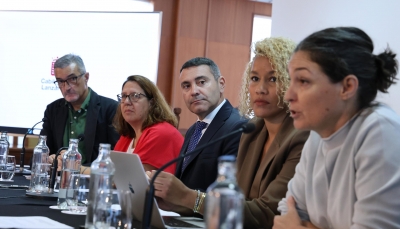
The Lanzarote Council has agreed in the second meeting of the Working Group Migrant Women, Gender Violence, Vulnerability and Equality, held this Monday in the Plenary Hall of the Institution, the elaboration of a framework protocol with the municipalities of the island with the aim of eliminating the administrative barriers that prevent hundreds of vulnerable migrant women from accessing their rights and essential services due to their irregular administrative situation.
This initiative has been the main result of the forum promoted by the Council, which counts with the participation of groups from the third sector and municipal representatives. On this occasion, professionals linked to the registration services of the municipalities of San Bartolomé, Teguise, Tinajo, Yaiza and Arrecife were present, while Haría and Tías did not attend.
The island's president has stated the importance of this specific action within the equality policies promoted by the Corporation: "Our intention is not only to make problems visible, but to promote effective solutions that improve the lives of these women and their families. With this protocol, we intend to eliminate the barriers that limit the access of many migrant women to basic rights such as health, education or social protection. The vulnerability of these women challenges us as a society and demands a firm and coordinated response from all administrations. For this reason, from the Council we are committed to being the bridge that connects the town councils and the entities of the third sector, providing tools to guarantee that no woman on our island is left behind. This is a first step, but we will continue to move forward with determination in the defense of their rights and in the improvement of their well-being", explained Oswaldo Betancort.
For his part, the Councilor for Social Welfare and Inclusion of the Lanzarote Council, Marci Acuña, who also chaired the Table together with representatives of the NGOs, emphasized the need to continue improving the registration process for women in an irregular administrative situation, a problem aggravated by the housing crisis.
"The Council has made a strenuous effort in this mandate to launch new infrastructures and resources aimed at female social inclusion. We have initiatives that are managed by groups such as Emerlan, Mararía or Flora Acoge, among others, and also with projects to address the vulnerability of migrants with organizations such as Acciones Unidas or Ecca.Edu", Acuña stressed, in a brief review of the numerous initiatives promoted by his Area; and then adding his personal commitment to continue working with third sector organizations in actions demanded by people in social exclusion.
Every three months
Precisely, from the third sector, and representing Acciones Unidas, one of its professionals yesterday thanked the Council for its mediation work and stressed that "there are hundreds of women who see their right to access education, health and other services limited because their administrative situation is not regularized".
The forum also included the presence of the Councilor for Open Government and Citizen Participation of the Lanzarote Council, Aroa Revelo, who reiterated the Institution's commitment to continue promoting spaces for dialogue and coordinated action with municipalities and social groups to ensure greater protection of migrant women in vulnerable situations.
The Working Group Migrant Women, Gender Violence, Vulnerability and Equality will be held periodically in order to evaluate progress and strengthen strategies aimed at the social inclusion of this group. In fact, Oswaldo Betancort pledged to convene it every three months, “because, as a public administration obliged to do so, we demand results from these meetings”, he stressed.


