
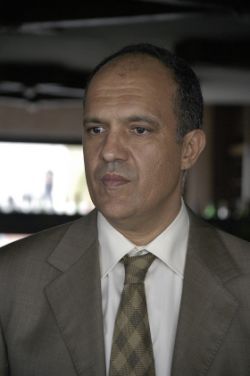
As the highest authority for Tourism in the Archipelago, what is your opinion of the Special Territorial Plan document and the controversy it has generated on the island?
I urge dialogue and consensus, because although the Cabildo has the competence, it will be based on municipal territories, so I understand that the mayors will have to say something, just as social groups and businessmen have to say something. That is to say, that this proposal should come from the combination of all efforts. Although we from the Autonomous Government have assumed our part of responsibility. We have financed, within the strategy of rehabilitation of urban centers, that of Tías, which contemplates the rehabilitation of the accommodation plant and the strategy in complementary offer. The one in Teguise is already being carried out, also financed entirely by the Autonomous Government. In addition, we have commissioned an analysis of the island's complementary offer, which is currently under intervention and that analysis will most likely be put out to tender in the next week's bulletin.
One of the points that has caused the most friction is the part of the complementary offer. Is it necessary or essential that it be included in this Territorial Plan, or can it be defined in a more leisurely way in a future document?
In all the Islands, the PTE includes the strategy regarding hotel offer and the strategy regarding complementary offer. I understand, fundamentally, that things have to be done well, and having said that, the more complete the documents are and the more content and parameters they analyze, the more valuable they will be, because it is always worse to analyze elements in isolation.
And in this context, what is your opinion of the statement made public by the César Manrique Foundation, in which it accuses "politicians and businessmen" of orchestrating an operation to put an end to the current model of containment of growth?
I understand that the Foundation plays a very important role in Lanzarote and, in addition, that it has an influence that goes beyond the island's borders. It has a supra-insular and supra-state dimension, if possible. It is one of the most prestigious elements we have in Lanzarote. I do not know the statement because I have not had the opportunity to read it, but I have been made some comments. And if there is a direct accusation, that there is collusion between some political parties or some mayors and business groups, and if the Foundation understands that this is punishable, I think it should go to the Prosecutor's Office, because otherwise I would be very worried.
And with respect to the current situation of tourism, are the latest figures that speak of a recovery of foreign tourists a relief?
We have been many months where there had been a gradual decrease in the influx of foreign visitors, although compensated by the arrival of peninsular tourism, but now it has been reversed. A few months ago I already commented that analyzing a series of parameters it was predicted that there would be a rebound, and so it was in the month of March throughout the Archipelago, with the only exception of Lanzarote. Fortunately in April, that recovery has been much more important and, in addition, Lanzarote has already joined that rebound or that abandonment of the red numbers, in what foreign tourist influx refers to. This rebound has been so important that in the whole of the Archipelago it has risen almost 17% in April. This has allowed us to compensate for the losses we had in the first quarter and, at this time, in the whole of the Archipelago we have a favorable balance, that is, there has been a net increase of almost 3%, with respect to the same months of the previous year.
And where do you think the causes of this rebound have been?
The causes are fundamentally that the Autonomous Administration is working in a coordinated way with the island administrations, and also with the operators, with the businessmen. We have a tool, which was very criticized at the beginning, which was Promotour. A company only dedicated to tourism promotion. Although the share capital is only from the Autonomous Government, the seven island tourist boards and business associations participate in the Board of Directors. This allows us to have a continuous forum for debate, where campaigns are presented, where everyone contributes and where the synergies produced by the promotions of the island centers are taken advantage of, as well as the proposals of the businessmen. And so we have reached the German market, the English market and the Nordic market with more power. In addition, the adverse circumstances in other destinations, which cause us all pain, the truth is that they make the security income that the Canary Islands has more valued, and that has also produced this effect.
The businessmen of the sector are cautious in this regard and do not want to talk about whether this rebound will be maintained in the future. As Minister of Tourism of the Canary Islands, do you consider that these circumstances can be prolonged in time?
I am just as cautious, but I allow myself to be moderately optimistic. It is true that the circumstances that are occurring at this time, can have continuity, if we continue working in an orderly manner, if we continue working with rationality and if we continue working in a coordinated manner between the central government, the island administrations and business agents. The parameters we have so far allow us to maintain that moderate optimism, to the extent that airport reservations also maintain a certain growth for the next winter and summer season, in addition to reservations by operating agents. It is true that there may be, at certain times, some declines in some of the island destinations because this rebound is not yet fully consolidated, but in the short and medium term we understand that the downward trend has been reversed and that we are on the right track, because we have done our homework.
To that data that we have known, to that rebound in the arrival of foreign tourists, are there other positive data for the sector such as the tourist spending they make or the average stay they have in the Archipelago?
There is an important change taking place in the sector, there are new strategies in transport, there are new strategies in promotion and the sector is also behaving differently. The big vacations in which our visitors were fifteen days or a month, well, unfortunately or fortunately, are part of history. Now people make shorter trips but, perhaps, instead of making one long trip, we make two or three short getaways. It is true that the average stay has decreased, but, even so, it is the highest in the State, since we are above seven days of average stay, almost eight. Lanzarote is above the average, in this specific case. But there is another important fact that does allow us to be optimistic, which is that in the only place in the State that tourist spending per capita rose in the first quarter was in the Canary Islands. It is not that it only remained, but that it fell in the rest of the autonomous communities, even in Catalonia. This is data from the Ministry of Industry and Tourism, of the Government of the State, which many people might think could be subjective. There was, then, a significant increase, both in spending at origin and at destination. This data has to be improved, of course it is clear, because we must not be complacent.
Changing the subject, very recently we were talking about the precarious situation of the Hotel School, is there any commitment, after the conversations that we know the Cabildo has had with the Ministry of Tourism, to be able to plan this Hotel School in the future, in such a way that with the collaboration of these two institutions the permanence of this teaching can be guaranteed?
It is a tremendously complex issue, but complex problems require complex solutions. For that, there must be inter-administrative co-responsibility. In addition, I understand that it should go further and that even the sector should be involved. The Government has assumed the commitment to make the analysis of what should be done. At this time, we have a school that we understand has played an important role, but things must have continuity. It has its strengths and its weaknesses. We must not forget that, already, by the Government of the Canary Islands there is regulated education, in the Archipelago and in Lanzarote, to that effect. Unfortunately, the same does not happen with the Hotel School and, as the same does not happen, something will have to be done. Then, it was requested by the one who has the competence, which is in the first instance the City Council of Teguise and in the second place the Cabildo, in what way we could participate. Remember that already last year, by the Government of the Canary Islands, there was an economic contribution and that this year there will also be one. But it is also true that if we want that to continue beyond the sensitivity of the minister on duty, we have to make rational approaches. To propose to have an approved school, to have a regulated school and that attends to the sectoral training of hospitality. Because it is true that we cannot waste public resources because we also have regulated and approved training. I also understand that the Hotel School, reorienting it, can play a very important role.


