
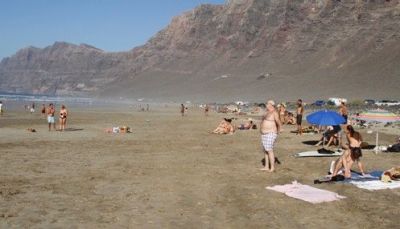
"Teguise has several beaches suitable for the use and enjoyment of bathers, but due to its special and well-known characteristics, Famara beach is not one of them." This is how Aetur argues the proposal to declare Famara as a "zone of sports tourism interest." An initiative that would entail, among other things, delimiting the bathing area and the sports practice area, and that the business association hopes that the City Council will consider in the ordinance that it is preparing to regulate the uses of the municipality's beaches.
This proposal has generated a debate about who should have preference on this beach, whether practitioners of water sports such as surfing or kitesurfing or bathers, since, in the document that Aetur has sent to the Consistory, it is suggested that it be the bathing area "that is delimited" and that there be "flexibility" when delimiting the sports practice areas, so that "they can move along the beach according to the waves."
However, aware of the controversy that these suggestions have raised, Aetur clarifies that it does not want to limit bathers, but simply "delimit business activity on this beach", so that "water sports companies have an area to develop their activity" since, according to them, currently "some users are harmed by the activity of others." "Delimiting one thing leads to the other," says the secretary of Aetur, Francisco Dorado.
Thus, as Dorado explains, the tourism association urges the Teguise City Council to create an area for sports practice that, according to him, would be located "beyond the Famara bungalows", so that the rest of the beach would be for bathers. "Bathers are usually in an area before the bungalows and walkers can walk wherever they want," adds Dorado, who insists that the beach has "kilometers to spare" so that there is space for everyone.
In this sense, Aetur's idea is to establish a space dedicated to kitesurfing and another to surfing, so that practitioners of certain disciplines can move "depending on the sea conditions", but "within a specific space and as long as other users are not disturbed." "Natural conditions are what mark sports activity. If there are going to be administrative concessions and there is going to be a payment, it is necessary to ensure the development of the activity and what marks the activity is the wind and the waves. Sometimes that wind and those waves stop and then it could be possible to move the surf zone to the kite zone. That is movable."
The voice of the users
However, Famara is a beach where, since "forever", athletes and bathers have coexisted, and many of its users, as is the case of Marga de Luis, do not understand very well why this proposal to divide the beach is coming now. "Famara is the only beach that remains free from tourist exploitation and the good thing about it is that one can put oneself wherever one wants. If it has a boundary, you take away all the grace," says this woman, who walks along the shore of the beach, next to her young son, precisely in the area of the bungalows, which would be the area that Aetur intends to be used for sports practice.
Therefore, Marga finds Aetur's proposal "absurd" and believes that "it is not necessary" to divide the beach. "We usually come with more people and with children, and they are children who from a young age are with the boogie catching waves and there are surfers and non-surfers, but I think that's the good thing. If one is aware of not getting where they can hit you with the board, nothing happens. You don't get in front and that's it. I see it that way," adds Marga de Luis.
"I enjoy this beach as a bather, as a surfer and I think that in the end all this is for business. Let them leave it as it is and that's it. It seems silly to me. If there are only people here in summer, nobody passes by in winter. You are here alone," says Paco Míguez for his part.
Others, however, are in favor of dividing the beach, but only if the bather has preference. "If the area does not occupy much of the beach, yes, but if they are going to take half of the beach, no. And the moving thing, neither, let them put a limited area and that's it, both for surfers and kitesurfers, and that that is the area they use," says David López.
Silvia Rojas, a young woman who, although she does not surf, believes that it is necessary to divide the beach, is of the same opinion. "I don't practice, but if I come to bathe I like to be relaxed on the beach." Her friend, Maikel Aparicio, who practices bodyboarding, sees it much more clearly. "Divide it now."
Máximo Sosa is a surf instructor and has been practicing this sport for 42 years. "It has never been a problem for me to be mixed with bathers. I control and I know how far they can go. The problem is the people who don't control the board much, because it also seems that there is a person and the wave takes you to them," says this man who, on the contrary, does consider that in the case of kitesurfing it can be dangerous. "Sometimes we are surfing or people are bathing and they pass by like blades," he adds.
Sosa claims to know "nothing" about Aetur's proposal and considers that this proposal is "more feasible" for kitesurfers than for surfers. "I am a surf instructor and I come with the school every day and we choose the site depending on the waves. What I do see feasible is that the beach is divided and the final area is for kitesurfers, who don't care what the wave is like. Surfers need more special conditions," he explains.
Luis, who is with his surfboard under his arm, about to get into the water, is of a similar opinion. "I think that what causes the most problems is the kite, which is more dangerous for the bather, although they usually put themselves in this area, in the final area. And maybe it's easier to close this area for them. Surfers do have to move. Today there are good waves here, but at the beginning of the beach there aren't, because they are closed, for example."
Other suggestions
Aetur's proposal is not only limited to delimiting the areas and declaring Famara beach as a zone of sports tourism interest, but the tourism association has also made a series of suggestions regarding technical aspects, training and surveillance, among others, for the City Council to take into account.
As explained by Aetur, the draft ordinance that the City Council intends to approve establishes that kitesurfing schools must teach their classes with a boat in the high seas, which must be handled by a skipper with the professional qualification to carry out the activity and may carry two students per monitor. A fact that, from Aetur, they consider "unfeasible". "They propose that a gentleman who has never done kite, put himself in the high seas, in Famara, with how dangerous it is," explains the secretary of Aetur, Francisco Dorado.
Likewise, the tourism association requests that the monitors have first aid training, so that they are considered "as the first element of assistance or help if necessary." "They have saved many lives. The first rescue is themselves and they have to be trained."
RELATED NEWS
[Avoid the proliferation of illegal schools->60661]
["Coexistence" and "good use" of the beach->60662]


