
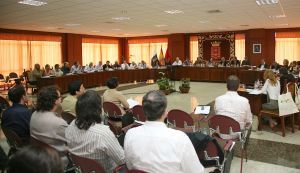
José María Ezquiaga, director of the drafting team for the revision of the Lanzarote Island Territorial Planning Plan (PIOT), visited the island this Friday and was present at the extraordinary session of the Biosphere Reserve Council, which has constituted the new Governing Board.
During the meeting, the architect assessed the first phase of the project, a draft that includes a first contact with the current situation of Lanzarote. A diagnosis that, as Ezquiaga himself pointed out, is "not so distant" from the Advance. "It has taken us a while to get the pulse of the island, but we don't mind extending the diagnosis phase a bit and bringing forward the Advance", explained the director of the Plan.
Ezquiaga is clear about it. The new PIOT should be conceived as an "integral plan" that focuses on economic diversification and sustainability, laying the foundations and the space to promote sustainable agriculture as well as the use of clean energies. All this taking into account that at the moment there is a more complex legislative context than that of 1991 (date of the current PIOT) that allows greater support to sustain the measures adopted.
Within this economic diversification, Ezquiaga has not left tourism aside. "It will continue to be a base for the island but we have to change our philosophy", the architect pointed out, alluding to the crisis of sun and beach tourism and ensuring that "there are many alternatives of complementary offer that have a low impact and a reasonable use of the territory".
José María Ezquiaga has highlighted the "enormously accelerated growth" that has taken place in Lanzarote in recent years. "The time variable is going to be important from now on", he explained. "It is necessary to establish rhythms that allow an adequate synchrony between a solid economy and the capacity to create stable employment".
The drafting team for the revision of the PIOT will work with a report on the situation of municipal planning in hand. For the moment, a prior report has been requested on the development of these plans, in order to then contrast the information and study the perspectives of each of them. "Many measures of the PIOT will only be feasible in relation to municipal planning", Ezquiaga assured. "Plans are successful when they are able to turn a culture into a norm", the architect stated.
GERM OF DEBATE
Among the members of the Biosphere Reserve Council are representatives of the island's political parties, the seven town councils, neighborhood, agricultural, hotel, environmental, business, immigrant, official associations, foundations, NGOs and trade unions. Many of them wanted this Friday to raise their doubts to José María Ezquiaga, which has unleashed the debate on some issues that affect the territory of Lanzarote.
One of them has been the irregular occupation of rural land and the situation of the tool sheds scattered around the island. "These rooms have a risk", Ezquiaga explained. "Our approach is that agricultural exploitations should be serious and in no case can they constitute a camouflage of an irregular second home".
Another of the themes that are part of the background of this PIOT is the architectural design, something that the representatives of the construction sector and the College of Architects of Lanzarote have brought to the fore this Friday. "This is a controversial and very interesting issue", Ezquiaga pointed out. "This island does not have a substrate of historical architecture, but some guidelines have been established that have given it an identity, an identity that, however, is invented". With this allusion to César Manrique, Ezquiaga was referring to the need to carry out an architecture sensitive to the natural and geographical context, paying special attention to the scale and the materials used. "The PIOT is not going to impose a priori architectural criteria, but I think that this is an important sub-debate that should be present in the elaboration of the Plan", added Ezquiaga.
In a globalized context where the hotels in Cancun are similar to those in Lanzarote, the director of the PIOT revision is committed to differentiation and quality as added value. "That doesn't cost more euros, it costs more to think about it", Ezquiaga indicated, raising a criticism towards the real estate products that are repeated in series and that leave no room for innovation.
In addition to architecture, during the meeting there was also talk of the "territorial dispersion" of the building, a phenomenon that the architect has defined as "a greater environmental risk than that of urban concentration in tourist areas". The drafting team of the PIOT has a double vision of the countryside and agriculture: on the one hand, economic, and on the other, as a creator of landscapes.
ACN Press


