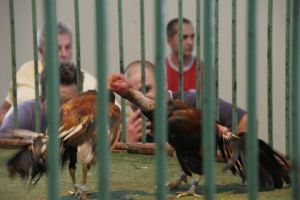
Cockfights in the Canary Islands date back to the early 18th century. They began in the House of the Colonels, in the town of La Oliva, where the specific care of roosters for fights began. It was later, at the beginning of the 19th century, when the Manrique de Lara family, the last descendants of colonels by appointment, dedicated themselves to the cultivation of this practice to such an extent that they achieved, through crosses between roosters, a own breed. Cockfights spread throughout the archipelago in an almost generalized way in the mid-19th century.
The main cities dedicated to cockfighting were
in Gran Canaria. But that doesn't mean that in Lanzarote went unnoticed. Antonio Cabrera and Blas Curbelo, captains of cockfighting in Arrecife, managed to arrange 27 fights in the 1859 season, setting the bet at 50 duros each fight and 300 to the general advantage. It was an activity that caught the attention of the entire Canarian population. Despite the amounts that were bet, there were also working-class fans who dedicated themselves to cockfights in a more humble way.
Today it is shown that things have changed. Betting is prohibited by law and, in addition, for a year now, there has been a body that is responsible for safeguarding the interests of this practice. Currently chaired by José Luis Martín, the Canarian Cockfighting Federation, as it is not considered a sport, is registered as a federation of breeding, selection and competition associations, where 24 associations from all over the archipelago are registered. The regional president approximated a number of seven or eight thousand people who are part of the different cockfighting arenas and associations in the Canary Islands, "that is without counting the fans who fill the arenas every weekend," he adds. The island of La Palma is the one that houses the most associations of this type since "there it is the national sport". José Luis Martín assures that the best thing about cockfights is breeding "because the fight itself only lasts ten minutes". The care and breeding work is crucial to get good fighting roosters. "They are cared for like elite athletes", says the president of the Federation. These animals have fruits such as Kiwi, papayas or tomato in their diet. But the roosters dedicated to fighting, in addition to having a healthy diet, must have a family tree of good specimens that genetically anticipate to the caster that the rooster is going to be good. Apparently they fight from a young age, that's why "they are treated with great care and separately", confirms José Luis Martín.
The fights in the Villa
"El Pollo de Oro" is one of the last cockfights held in the Canary Islands. It is a regional championship that took place two weeks ago and was attended by fans from all the islands. This fight organized by the La Villa cockfighting arena is held in a tent located in the Agroindustrial Complex of Teguise. The competition is not like the rest of the season's fights since it deals with roosters that are no more than 16 months old and that face each other in the fence for ten minutes. The jury, after this time limit, is the one that decides which is the specimen that wins the fight, although in many cases the fight ends early with one of the roosters killed.
The animals do not get tired, they peck and strive to prevail in the fight. And what makes this practice attractive to fans is that, more than once, the rooster that was considered lost has surprised the public with a start that leaves his opponent out of the fight.
"El Pollo de Oro" is not a competition by cockfighting arenas, it is a fight in which the casters individually choose their best chickens. Each participant can present three chickens, and the sum of the results of each fight is the score that is taken into account at the end to determine which caster is the champion. The fight lasts very little but it is intense. In the end, one of the roosters falls to the ground, but the responsible caster tries to lift it by the wings three times. The third time is the charm and if the rooster does not respond, the fight is decided.
In "El Pollo de Oro" it was the roosters of Eladio Mérida, a caster from El Hierro, who won the competition. The Negrín Brothers, from Lanzarote, took second place. The roosters of Francisco de Paz, from La Palma, achieved third place and the title of the fastest rooster.
The fighting rooster: Different by instinct or used for the entertainment of humans?
There are many voices against cockfights, who see in this practice an abuse by humans and against animals. Normally the reason why discrepancies occur lies in the existing dichotomy between tradition and cruel practice. For example, the world organization for the protection of nature, ADENA, believes that this practice should be prohibited in the Canary Islands as in the rest of the country. But if there is a federation in the Canary Islands it is because there are people who support cockfights. The president of the Canarian Cockfighting Federation, José Luis Martín, respects people who do not like cockfights but "that they do not attack us because if it were not because there are fights, this species would have disappeared because they are not good for eating".
For his part, the head of ADENA in the Canary Islands, José Trujillo, states that these fights "cause serious problems to the animals, and it has been shown that they suffer and die, that is why we understand that it should be illegalized". In addition, Trujillo asserts that "the cruelty is also in the fact that when a rooster is no longer useful for the fight, it is sacrificed". On the other side of the debate, the president of Canarian cockfighting clarifies one more argument in his favor and that is that he complains that cockfights are compared with bullfights, "and it must be understood that they are very different since in this case it is a fight between animals in the same conditions, with the same weight and the same age, and bullfighting is a confrontation between the armed rational animal and the irrational one". From ADENA, Trujillo, assures that these are different things "but the case of cockfights is still a show caused for the entertainment of humans".
Finally, within the cockfighting environment, all breeders agree that from a young age the chickens have to be separated because "they are in a continuous hierarchical struggle and their instinct is to kill the rival". According to many fans, "there are chicks that have been killed at two days of age", in addition to ensuring that "if two roosters hear each other at a great distance they go to meet to fight". In this regard, the head of the environmental organization disagrees by commenting that "the fact that the rivalry between roosters is instinctive is true, but another thing is that they are trained and put in a specific place with the sole objective of killing each other", in addition to differentiating the fact that "one thing is instinctive competition and another thing is to promote the show with the fight and death of the animals". ADENA highlights that cockfights "are associated with the money that fans gamble by betting on one animal or another, something that seems pathetic to me even if they talk about tradition", comments Trujillo.
From ADENA, as its representative comments, they do not try to fight against popular practices but "there are traditions that should be prohibited due to their violent nature against animals". Finally, José Luis Martín stressed that the Federation tries to ensure that there is no money at stake, but admits that what happens outside the arena is not the responsibility of the organization, but of justice. "We cannot control what happens outside the competition although we can denounce it". He also declares that they are protected by the Animal Protection Law of 1991 that does not prohibit fights in places where there is tradition.
Breeding and training
The breeding of the rooster occurs long before the egg is laid. It is a process by which the "caster", which is what the person in charge of carrying out the crosses of castes is called, chooses which roosters and hens must be mated so that the result is a competition rooster. Then comes the part with which, according to many, is most enjoyed. It is about feeding, deworming and the care that the rooster requires in general. Martín comments that "the ten minutes of fighting are the least of it", but the head of ADENA does not find sense to the whole process of caring for the roosters because "it is a continuous training", he concludes.



Add La Voz de Lanzarote as a preferred Google source.
Stay informed with the latest current news.