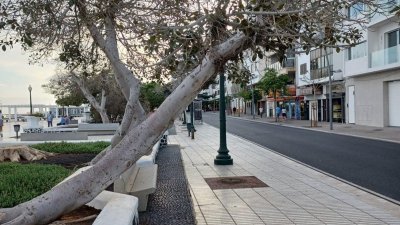
Julieta Shallenberg, Deputy Minister of Ecological Transition of the Government of the Canary Islands, spoke this Friday on the program Buenos días, Lanzarote of Radio Lanzarote-Onda Cero to talk about the climate shelters project in Lanzarote and the rest of the archipelago.
The deputy minister explained that these climate shelters are "the main tool we have to defend ourselves from heat waves and will help us withstand them better." She also mentions that, "while they are trying to reduce CO2 emissions in the Canary Islands, the consequences of climate change are already being seen."
In addition, she highlighted that there are three consequences of climate change, such as more frequent, more intense, and longer-lasting heat waves, haze, and rising sea levels. She also clarified that "climate shelters focus on the consequence of heat waves, although they are working on the other two."
However, with regard to Saharan dust plumes, it is more complicated. "We are working in a different way with green barriers in the Sahara, and we are measuring those dust plumes and preparing ourselves with alerts," he said.
Shallenberg distinguishes two types of climate shelters: indoor and outdoor or green. He explained that they have chosen Lanzarote as a pilot project within the Canary Islands for indoor shelters and are locating buildings/indoor areas and refining protocols with the town councils to create a network of indoor climate shelters in the Canary Islands.
On the other hand, she emphasized its dissemination. "It will be published online in the Grafcan viewer, and we are looking to include it in Google Maps so that people can see where to go. This allows a vulnerable person without air conditioning in their house to know where to go, such as a library that is open all day," she specified.
The aim of climate shelters is to ensure that the temperature does not rise above 25 degrees, to ensure that people can stay as long as they want, and to offer water and seating. There are approximately 10 requirements, although these are the most important.
This initiative will allow any entity, public or private, that adheres to it, although private entities must seek adhesion voluntarily. "The idea is to allow an application that helps to find the nearest shelter if someone feels unwell on the street," he highlighted.
Characteristics that climate shelters should have
Regarding the characteristics of these spaces, they must have more than 500 square meters, more than 75% shade coverage (usually vegetation, but also pergolas), and have benches and water. Its function is to provide shade in urban environments to reduce the heat island effect.
The vice president also highlighted the importance of permeable pavement (not cement) so that water drains when it rains and heat does not emanate when it is sunny.
Julieta Shallenberg has revealed that "they are looking for areas in Lanzarote to declare them green climate shelters," although she acknowledges that "there are few green shelters in the Canary Islands and more trees and green areas are needed."
Furthermore, he lamented that "reclaimed water is not being used in the Canary Islands, with less than 20% being used and the rest being dumped into the sea in most cases." He concluded by saying that "we must think holistically, using reclaimed water for parks and gardens."


Add La Voz de Lanzarote as a preferred Google source.
Stay informed with the latest current news.