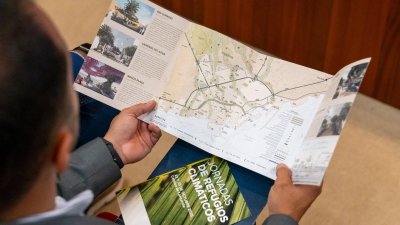
The Department of Ecological Transition and Energy of the Government of the Canary Islands, through the European project PLANCLIMAC2, of the Interreg MAC 2021-2027 Territorial Cooperation Program, celebrated this Wednesday the beginning of the 1st Conference on Climate Shelters, which takes place on October 22 and 23 at the headquarters of the Cabildo de Lanzarote.
The Deputy Minister of Ecological Transition, Fight against Climate Change and Energy of the Government of the Canary Islands, Julieta Schallenberg, explained that this meeting is the perfect opportunity "to present the guide for the creation and/or adaptation of green climate shelters in the Archipelago."
This document, he stated, "is born with the aim of publicizing the technical details necessary for the construction of these enclaves on the islands, facilitating the work of island councils, city councils and other entities, and thus favoring their correct design. A tool that, without a doubt, will help us combat heat waves and will also improve the quality of life in urban environments."
As he explained, some of the technical criteria included in this guide are tips regarding "the surface area of the selected green space, the choice of plant species, the characteristics of the pavement, the irrigation system, or the street furniture."
During her speech, the Deputy Minister highlighted that "the Canary Islands wants to be a benchmark in climate adaptation, especially in island territories, which are the most vulnerable to the impacts of global warming," which is why the Ministry itself "is working on the construction of climate shelters on islands such as Gran Canaria, Tenerife, or La Palma."
To further boost this, these first conferences are being held, "where those interested in the subject will be able to learn about successful projects developed in Spanish and European regions, as well as resolve any doubts they may have about it."
In addition, he detailed that the celebration of these conferences, which coincide with the week in which the International Day Against Climate Change is commemorated, which is celebrated on October 24, have allowed progress in the development of the future Canary Islands network of climate shelters that is being promoted by the Executive Branch "and that will allow all Canary Island citizens to know the places to which they can go in the event of a considerable increase in temperatures and heat waves."
For his part, the mayor of Arrecife, Yonathan de León, emphasized that for "Arrecife, working on planning for climate change, hand in hand with the experts who work for the Ministry of Ecological Transition of the Government of the Canary Islands, is a challenge, but we also know that this roadmap must be followed, yes or yes," and he was pleased that this important guide, which proposes the measures we must adopt to adapt as cities to climate change, is being made available to the municipalities of the Canary Islands.
"In Arrecife," the mayor remarked, "we have already approved different initiatives and works that go in that direction. Even in the new Supplementary Plan, we are allocating 287,000 m² of new urban green areas, which will almost triple the coefficient of green spaces per inhabitant (from 2.2 to 6.4 m²/inhabitant). A city with trees and shade will be better prepared for the increase in temperatures.”
The Councilor for the Environment and Biosphere Reserve of the Cabildo of Lanzarote, Samuel Martín, stressed that "this guide will be a fundamental tool for city councils and local administrations, as it offers the necessary technical criteria to create spaces that improve the thermal comfort and environmental quality of our municipalities."
"On an island like Lanzarote, where adaptation to climate change is an urgent necessity, these types of initiatives are not only a response, but also an opportunity to rethink our urban spaces from a more human, green, and sustainable perspective. We're talking about parks, schoolyards, plazas, or community centers where nature and architecture come together to offer well-being, especially to the most vulnerable groups," Martín added.
A conference of exchange, synergy, and international references
In addition to the presentation of the technical guide for the creation and/or adaptation of green climate shelters and the progress in the creation of the future Canary Islands network of climate shelters, the program has included technical presentations, round table discussions, and a guided tour of several points in Arrecife, where spaces that already act as climate shelters and others with the potential to be transformed into thermal comfort zones in the future will be identified.
The meeting included presentations by prominent national and international speakers and top-level specialists, such as Javier Martín Vide and Salvador Rueda Palenzuela, as well as representatives from the Spanish Office for Climate Change, the Andalusian Office for Climate Change, and specialists from Portugal. The speakers addressed the role of green urban climate shelters as an adaptation measure against the increase in the intensity and duration of heat waves, a phenomenon that is increasingly frequent in island environments.
PLANCLIMAC2 Project
These Lanzarote conferences are part of the PLANCLIMAC2 project's actions, whose objective is to strengthen regional cooperation against climate change, promote adaptation, and strengthen the response capacity of island territories to environmental risks. To carry out these actions, a total budget of 3,582,873 euros is allocated, co-financed at 85% through ERDF funds.
This project is made up of twelve partners with representation from the Canary Islands, Cape Verde, the Azores, Madeira, the two universities of the Canary Islands, ITER, Gesplan, Ghana, São Tomé and Príncipe, and the Ivory Coast.


Add La Voz de Lanzarote as a preferred Google source.
Stay informed with the latest current news.