
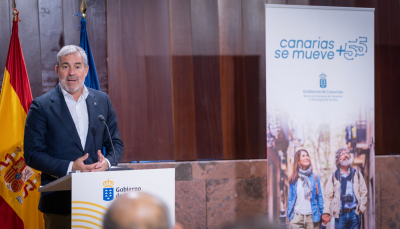
The head of the Canary Islands Government, Fernando Clavijo, admitted this Monday that "there will be more tents" in Canary Islands ports to provide initial care to migrants, such as the one installed by the administration he leads in Lanzarote, if there are no responses from the Government of Spain.
Clavijo has considered that this type of infrastructure "is the representation of a failure of migration policy" and reflects the "inability" to assist and refer in a dignified manner the hundreds of people who arrive daily to the islands aboard precarious boats.
"If there are no responses, there will be more tents, there is no other choice, and blessed tents. The opposition criticized me when the one in Lanzarote was set up, and yet, it was the State that asked me for it to be able to assist the people who arrived last weekend," he asserted.
However, initially, the Canary Islands Executive had announced the installation of these tents to accommodate migrant minors, a decision questioned by the Prosecutor's Office as it violated the rights of minors arriving on the islands in precarious boats.
Clavijo insisted that "the ideal is that there are no tents and that we have a system that can assist them," although he assured that "we are not having it because the Government of Spain has not put either the resources or the attention or the political will" for it.
During his speech at the informative meeting organized by the Canary Islands newspapers of the Prensa Ibérica group, in which he answered questions from journalists from local newspapers and other autonomous communities, Fernando Clavijo defended the "Canary Islands way" of doing politics against the polarization that prevails in the peninsular territory, especially in the Congress and the Senate.
Therefore, he estimated that "breaking relations" in a negotiation that tries to establish a mandatory mechanism for the referral of unaccompanied migrant minors among all the autonomous communities, through the modification of the Immigration Law, "is useless for the day after," since this phenomenon does not cease and must continue to be managed.
"The day I feel like breaking up, I'll go home, breakups cause problems to become entrenched," he said in relation to the PP's actions in this matter.
The Canary Islands president has assured that he puts institutional loyalty before the differences that the administration he leads maintains with the state on various issues, such as migration, and has defended the need to "reach the conference of presidents with a proposal" that contributes to alleviating the impact that this phenomenon causes on the social services of the archipelago.
In his opinion, the possible visit of Pope Francis to the islands, about which he estimates that "there are signs," such as the recent reception that the pontiff gave to the Spanish president, Pedro Sánchez, "may accelerate the achievement of political agreements" aimed at the legal modification that this region is calling for.
For Clavijo, "the EU has not failed the Canary Islands" when it comes to helping manage its humanitarian emergency due to the continuous arrival of people aboard cayucos, inflatable boats and pateras. It has, he said, "the Government of Spain and the entire political class."
"The aid that has come from Europe, Spain has used it to assist adult migrants, not minors. We cannot hide behind a Minors Law of 2000 and say that the powers belong to the autonomous communities, what if 300,000 arrive?" children, he asked, stating that the powers over "immigration, borders and concurrence" belong to the State.
The Canary Islands president has stated that "minors arrive in the Canary Islands" because the Government of Spain "does not exercise its constitutional obligation to control borders" and has warned that the administration he leads will continue to seek agreements with Morocco and other Spanish communities to guarantee that migrant minors are given dignified care, which not only involves housing them in centers, but also integrating them, giving them a language, schooling them and offering them a life project.
Right now that cannot be given and in the Canary Islands there are more than 2,000 unaccompanied foreign minors without schooling due to various problems, including the obstacles that exist to register them, he asserted.


