
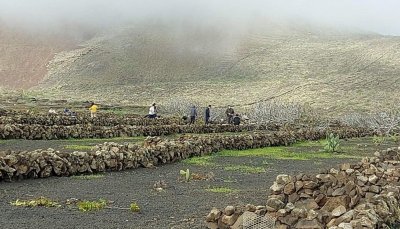
The Governing Council of the Cabildo de Lanzarote approves the signing of a framework collaboration agreement with the Haría City Council for the development of joint actions at Finca Agroambiental Los Lajares, a municipally owned space with an approximate surface area of 100,000 square meters and with relevant agricultural, ethnographic, and geological values.
The agreement establishes a framework of institutional cooperation to intervene on this strategic enclave, with lines of work linked to agro-environmental research, specialized training, the recovery of native species, and the dissemination of the island's natural heritage.
The president of the Cabildo, Oswaldo Betancort, points out that this agreement allows to order and coordinate the work between administrations in a space that concentrates agricultural, environmental, and educational values. "The farm of Los Lajares is a useful tool to connect technical knowledge with the primary sector and with the citizenry," he points out.
Along the same lines, the Geopark counselor, Samuel Martín, highlights that “the intervention on Los Lajares is approached from a logic of integral territory management, incorporating criteria of biodiversity, geodiversity, and public use. The objective is to consolidate this space as a reference in conservation and in training applied to the natural environment”.
A space with an agrarian, environmental, and educational function
La Finca Agroambiental Los Lajares has consolidated itself as a local development project that has three main functions: agrarian, through experimentation with traditional crops; environmental, with actions aimed at the conservation of native flora and fauna; and educational, with an area enabled for guided visits and outreach activities.
“From UNESCO Global Geopark Lanzarote and Chinijo Archipelago, we develop conservation, dissemination, and participation actions in different parts of the island, combining scientific knowledge and territory management. The Los Lajares Agro-environmental Farm is incorporated into that work logic, allowing the application of that same model in a space with the capacity to integrate agriculture, biodiversity, and on-site training,” adds councilor Samuel Martín.
The approved agreement will allow to articulate concrete actions such as the improvement of infrastructures, the recovery of crops, the installation of irrigation systems, the signaling of the space or the development of research and training programs. Furthermore, it contemplates the creation of a monitoring commission between both administrations to guarantee the control and execution of the planned actions.
This agreement will have an initial term of four years and will serve as a basis for the signing of specific agreements that specify technical actions and financing according to the needs of the space.


