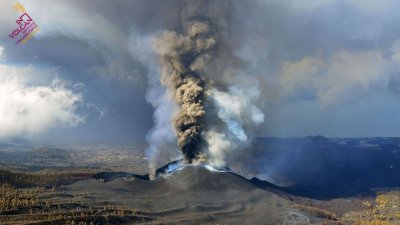
The Consejo Superior de Investigaciones Científicas (CSIC), an agency attached to the Ministerio de Ciencia, Innovación y Universidades, has co-led a study that reveals the dual role played by large geological faults, which, on the one hand, would be capable of both guiding the ascent of magma and stopping it. The finding, published in Nature Communications, is the result of the study of an intense episode of volcano-tectonic activity on the island of São Jorge, in the Azores, in March 2022, where thousands of earthquakes were recorded, but which did not end in an eruption. The results of this discovery provide a new conceptual framework to improve the prediction of volcanic risks.
The scientific team meticulously reconstructed the movement under the island of the magma and, for this, used ground deformation data from radar satellites and GPS stations, together with very precise earthquake locations obtained through a dense network of terrestrial and ocean-bottom seismometers. Thanks to them, they discovered that the magma ascended almost vertically through a flat, almost rectangular-shaped conduit known as dike, and it did so rapidly from more than 20 kilometers deep to just 1.6 kilometers under the island, where it stopped. A large part of this ascent occurred in a “silent” manner, with very little seismic activity and, once the magma stopped ascending, most of the earthquakes felt by the population occurred.
“It was a stealthy intrusion,” says lead author Stephen Hicks, from the University of London (UCL). “The magma moved rapidly through the crust, but much of its trajectory was silent, which made it difficult at the time to predict whether an eruption would occur or not.”
Satellite observations and their modeling, carried out by the CSIC, showed that the volcano's surface rose 6 centimeters, which confirms that the magma had penetrated the upper crust. However, the intrusion stopped before reaching the surface, giving rise to what is called a “failed eruption”. Thus, this type of intrusion contributes to the growth of islands and this study has shown how this process occurs.
A particularity of the magma's ascent is that it did so through one of the island's main fault systems, that of Pico do Carvão. Previous geological studies indicated that this fault has generated large earthquakes in the past. However, instead of producing a large earthquake, the magmatic activity generated numerous small earthquakes grouped along this fault.
Dual role of large faults
The team interprets that the faults can guide the magma upwards, but also allow volatile gases and fluids to escape from the magma laterally along the fault, which resulted in a reduction of magma pressure and contributed to stopping its ascent. As explains Pablo J. González, lead co-author of the study and CSIC researcher at the Institute of Natural Products and Agrobiology in Tenerife, “the fault acted both as a highway and a leak or, in other words, it helped the magma to ascend, but it could also have prevented the eruption”.
The results of this study show that magmatic intrusions can occur rapidly and with minimal precursor signals and that large geological faults are capable of influencing whether magma erupts or remains trapped underground. “It must be remembered that large faults, like those of Azores, do not exist in all volcanic zones on the planet, but a large part of this discovery is transferable to other volcanoes, including those of the Canary Islands,” adds González.
In this regard, Ricardo Ramalho, co-author from Cardiff University, points out that “the study served as support to local authorities in the evaluation of a possible volcanic threat, highlighting the value of combining terrestrial and marine geophysical data for precise detection and localization of seismic events and ground deformations”.
This research is a good example of what an international scientific collaboration can achieve: the article is signed by research staff from fifteen institutions in the United Kingdom, Spain, and Portugal. In addition to University College London (UCL) and the Consejo Superior de Investigaciones Científicas (CSIC), also included are the universities of Cardiff, Manchester, Lisboa, Évora, Beira Interior and the Algarve, the Centro Internacional de Investigación del Atlántico (AIR), the Instituto Politécnico de Lisboa, the Centro de Información y Vigilancia Sismovolcánica de las Azores (CIVISA), the Instituto Portugués del Mar e de la Atmosfera (IPMA), and the Laboratorio Colaborativo de Geociencias (C4G). In addition to this “great collective effort and clear example of transnational cooperation between academic and civil institutions,” as highlighted by Ana Ferreira, co-author from UCL, a key factor in the work was the rapid response that allowed the achievement of “urgent funding from the Natural Environment Research Council (NERC) to access equipment from its Geophysical Equipment Facility (GEF)”.
This work has been funded by grants and research projects from: la Agencia Estatal de Investigación (Ministerio de Ciencia, Innovación y Universidades, Gobierno de España), the Natural Environment Research Council (NERC; Reino Unido), the European Research Council (ERC), Fundação para a Ciência e a Tecnologia (FCT; Portugal), Gobierno Regional de las Azores, with field support from the Armada Portuguesa. The geophysical equipment was provided by the Geophysical Equipment Facility (GEF) of the NERC (Seis-UK for seismometers and OBIC for ocean-bottom seismometers).


Add La Voz de Lanzarote as a preferred Google source.
Stay informed with the latest current news.