
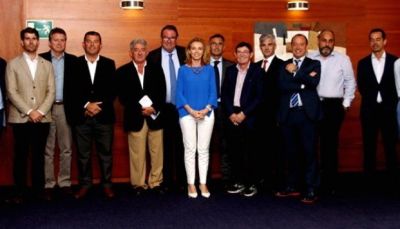
The Asolan tourism association has expressed its "concern" after what happened in the Cabildo Plenary Session held this Tuesday, where the subsidy of 665,000 euros that the government group intended to grant to this business association was finally not approved. Although the president of the Cabildo, Pedro San Ginés, refused to give explanations as to why it was not finally submitted to debate, the truth is that the decision occurred after the public complaint made last week by the Podemos group in the Cabildo.
It was last Thursday when the party sent a statement criticizing that the government group intended to allocate almost 700,000 euros to Asolan "for projects that it does not even understand". And it is that in the Finance Committee held last week, the councilor of the area, Luis Arráez, could not explain what the projects consisted of and ended up summoning the councilors to a meeting this Monday with representatives of the employers, so that they could detail its content.
However, despite the fact that this meeting took place the day before the Plenary Session, the government group finally decided not to take this matter to the plenary session this Tuesday, apparently because there were discrepancies within the government group itself and they did not have the necessary votes to approve it. However, San Ginés did not want to explain the reasons when asked by the opposition and also did not clarify whether they intended to try to approve it later, although the employers' association states in its statement that "Asolan and the Cabildo will continue working so that these and other Innovation and new technologies projects are developed in Lanzarote".
Talks about "threats" for the arrival of tourists
A day after that Plenary Session, the employers' association "regrets" in a press release that "some political groups represented in the Island Council prevent investments in innovation and new technologies". And although the employers' association does not specify which groups it refers to, there is an implicit allusion at least to Podemos, who made this issue public.
In that press release, the employers' association speaks of a "blockade" of these projects, called "WOW Guest Experience Lanzarote", "Data2Client" and "IV Biosphere Smart Hotel", and links their implementation to the arrival of tourists to the island. Thus, although the island has been breaking historical occupancy records in recent years, Asolan speaks of "a series of very important threats" to the sector with the "opening of competing markets, such as Turkey, Egypt and Greece, added to the speed of technological change".
According to the employers' association, this "threat" is already being "reflected in this year's occupancy prospects", and argues that the way to deal with it is "by increasing its investments in technology and in improving the Customer Experience", which is what they had requested this subsidy from the Cabildo for, through the FDCAN funds.
The president of Asolan, Susana Pérez, maintains that the projects for which they requested this subsidy "would promote a business investment of more than 2 million euros, generating a positive impact on the diversification of other economic activities of high knowledge and technology and on qualified employment". However, one of the aspects that Podemos denounced is that the subsidy that the government group of the Cabildo intended to approve covered one hundred percent of the estimated value of these projects, when the usual thing is that the administration subsidizes only a part.
Argues that there is a "risk of losing those funds"
In its statement, Asolan alleges that the subsidy it intends to receive would arise from the FDCAN funds destined for Innovation, which therefore cannot be used for other purposes, and argues that "public administrations have a limited capacity to execute their budgets, public works or attend to the basic services of citizens", so it argues that if they do not give them that money, "there is a risk of losing those funds for innovation in Lanzarote".
"The non-investment in innovation, as well as training in digital skills for workers or the unemployed, puts the employment of residents at risk in favor of qualified personnel from outside", even the Asolan statement states, which affirms that "no Innovation Managers program launched by the ACIISI has been able to be carried out in the tourism sector in Lanzarote, since there has been no candidate from the island in the latest calls" of this program, which is "included in the Guest Experience Lanzarote project". "This situation excludes the island from being at the forefront of the sector, much more advanced in other territories", says Asolan
Regarding the Data2Client Project, it states that "it allows to know the digital tourist, directly and positively impacting the diversification of tourism products such as Saborea Lanzarote, ESD, sustainable tourism, active tourism, among others, enhancing the knowledge of these in origin at the time of inspiration of the tourist, prior to their purchase decision, thus increasing direct sales, minimizing intermediation and thus increasing tourist spending at the destination, and therefore its impact on the economy and job creation".
Asolan has "obtained" more than 9 million public euros in 9 years
The employers' association itself explains in its statement that in the last 9 years, Asolan has "obtained" more than 9 million euros in public subsidies, which it claims has "generated a business investment of more than 37 million euros". In addition, it defends its "management" in that period as CIDE Turismo Lanzarote, acting as "center for innovation and business development of the tourism sector on the island", which "has advised more than 230 business projects".
In this regard, it regrets that Lanzarote, "being the third island" of the Canary Islands, "only has two Innovation Centers, Asolan for the Tourism sector and the Chamber for the rest of the sectors", while "other islands such as Gran Canaria and Tenerife have more than seven Innovation and Technological Centers in each one, which represents a large public investment destined directly and indirectly to the business sector of the capital islands".


