
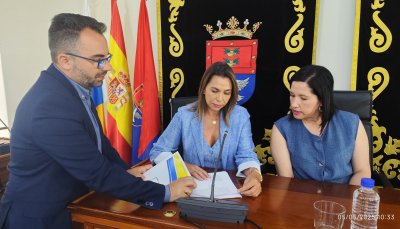
The Arrecife City Council has provisionally approved this Monday the new regulatory ordinance for aid for the acquisition of textbooks, school supplies, computer equipment, uniforms and sportswear. The Department of Social Welfare, led by Maite Corujo, has promoted this modification with the aim of expanding the scope and improving access for the most vulnerable families to these essential aids for the next 2025-2026 school year.
Likewise, the capital Consistory has taken a decisive step this morning to complete the General Ordinance of Subsidies with the approval of the specific bases that will regulate the calls for the Education area, led by councilor Abigail González, and has given the green light to the 2024 Financial Economic Plan (PEF), after verifying the "non-compliance with the spending rule" in the settlement of the 2024 municipal budget, as announced by the Deputy Mayor and Councilor for Finance, Echedey Eugenio.
The consistory defends that this new ordinance introduces "important novelties that make access requirements more flexible and reinforce the social character of the aid." Among the main changes, the increase in the family income limit stands out, which leaves behind the fixed limit of 18,000 euros and replaces it with a scale adjusted to the number of members of the family unit, with sections ranging from 25,200 to 61,200 euros.
Likewise, the concept of family unit is redefined to focus on the nuclear family, avoiding penalizing households where other adult relatives live together who until now could negatively influence the economic evaluation. The period of residence required in the municipality is also reduced to six months to be eligible for these aids, compared to the twelve months previously required.
Regarding the subsidizable education, the covered training levels are expanded, including for the first time the first cycle of Early Childhood Education, and geographical and ownership restrictions of the educational center are eliminated, allowing beneficiaries to study in any municipality.
The Councilor for Social Welfare, Maite Corujo, has highly valued the approval of this new ordinance, stating that “with these changes we are taking an important step towards a more just social policy adapted to the reality of our families. This ordinance is more sensitive, more equitable and more effective,” she said.
In the new scoring system, the per capita criterion is introduced, that is, the income will be divided among the number of family members, which allows for a fairer assessment. In addition, additional scores are awarded to large or single-parent families, attending both to those who have greater family burdens and to those who face parenting alone.
Another of the substantial improvements affects the amount of aid, which is no longer fixed and will be established in three sections of 250, 200 and 150 euros, depending on the score obtained, thus favoring the most vulnerable profiles with higher amounts.
Regarding the required documentation, the procedure is streamlined allowing families to present the enrollment certificate for the current course or, failing that, a provisional responsible declaration at the time of application, which speeds up the process and avoids unnecessary delays.
After its provisional approval in the Plenary session this Monday, the ordinance will be exposed to the public during the month of May for possible allegations. If none are presented, it will be definitively approved at the beginning of June, at which time an information campaign will be launched aimed at the AMPAS, educational centers and citizens in general, explaining the novelties and the procedure to apply for aid.
The City Council estimates opening the application period from June 15 to July 15, with the aim of having the final resolution published in the month of November, after a process of study, document review and technical evaluation that will take place between the months of August and October.
First subsidies to the AMPAs
On the other hand, the Arrecife City Council has today taken a decisive step to complete the General Ordinance of Subsidies with the approval in Plenary of the specific bases that will regulate the calls for the Education Area, led by councilor Abigail González. This measure will allow the activation of two key lines of aid aimed at the educational community of the municipality.
On the one hand, aid to transport for students who are studying outside the island is consolidated and reinforced, which will benefit around 600 young people. For this academic year, these aids reach an amount of 350,000 euros, a figure that has increased compared to previous calls.
“The economic situation of many families requires that administrations be up to the task. These aids will alleviate the economic burden of students and their families, and encourage our young people to continue training outside of Lanzarote without the cost of transportation being an impediment,” said councilor Abigail González.
In addition, for the first time, a line of subsidies aimed at associations of mothers and fathers of students (AMPAs) is included in the call. These aids will be destined to support activities organized by the AMPAs that contribute to enriching the educational experience of Infant and Primary students.
2024 Financial Economic Plan approved
In the same plenary session, and before the expiration of the legal term, the Plenary also approved the 2024 Financial Economic Plan (PEF), after verifying the non-compliance with the spending rule in the settlement of the 2024 municipal budget.
The intervention report dated March 5, 2025 recognizes that, although the approved municipal budget was 63,716,572.52 euros, the consolidated expenditure amounted to 72,177,346 euros, exceeding the limit allowed by law by 6,804,142.96 euros. This gap is largely due to the incorporation of remnants from previous years and the payment of pending obligations charged to the 2025 budget, as explained by the Deputy Mayor and Councilor for Finance, Echedey Eugenio.
Despite the technical non-compliance with the spending rule, in a statement the City Council defends that the report "collects the financial soundness of the City Council and proposes the approval of the PEF as a corrective measure." Among the measures contemplated are: the reduction of expenditure through economies of scale and tenders compared to minor contracts, the unification of municipal services to improve efficiency, the adjustment in the incorporation of remnants, adapting them to their degree of executability, the modification of the waste ordinance in compliance with state and European legislation and the reinforcement of the infractions area to improve the expected collection.
“The Financial Economic Plan does not respond to a situation of deficit or economic imbalance, but to a technical adjustment derived from compliance with fiscal rules. Our economic situation is solvent, but we must adapt our management tools to the current regulatory frameworks,” explained Echedey Eugenio.
The Plan has been approved urgently because the legal term of two months from the settlement of the budget expired this Monday.


