
The environmental coordinator of Lanzarote, Alcogida, has expressed its rejection of the installation of marine cages on the coast of Playa Honda and has denounced that the Government of the Canary Islands has not yet reopened the new period of allegations that it promised two weeks ago.
The environmental group has asked the candidates, both to the Cabildo of Lanzarote and to the Government of the Canary Islands, for the elections of May 28 to express their rejection of the marine cages. After the "unanimous" refusal of the members of the Council of the Biosphere Reserve of Lanzarote, the Government of the Canary Islands announced that it would open "imminently" a new period of allegations, recalls the environmental coordinator.
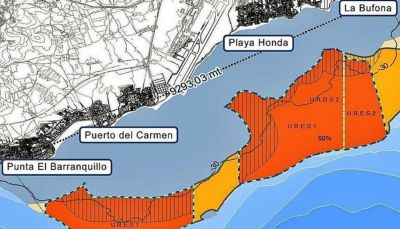
For the moment, the project has been awarded to the company Yaizatún to install 56 marine cages between Arrecife and the César Manrique-Lanzarote Airport, "fully occupying the coast of Playa Honda", adds Alcogida. "However, to this day, this period of allegations has not yet been opened. Different associations, sports clubs, businessmen and athletes of the island had already expressed a similar rejection."
It is a sheet of water located about 2000 meters from the beach of Playa Honda, located specifically in the Aquaculture Interest Zone ZIA LZ-2 according to the Regional Plan of Aquaculture Planning in force, with a global area of 13.5 million square meters, destined to the fattening of 9,000 tons of fish per year, with a forecast of a total of 350,000 sea bass and 400,000 sea bream per cage.
Although in his visit to Lanzarote, the President of the Government of the Canary Islands assured that: "If they say yes, it would be yes. If they say no, it is no in relation to the installation of marine cages in each of the islands, it seems that the Cabildo of Lanzarote does not trust a Government of its own party, and, according to press reports, it would have judicially challenged the resolution of the General Directorate of Fisheries of the Government of the Canary Islands to install the aforementioned aquaculture cages", says Alcogida.
A project that "does not conform" to the regulations
The cages are intended to be installed in an area that coincides with the delimitation of the Site of Community Importance "Marine area of the east and south of Lanzarote and Fuerteventura" and with the Special Conservation Zone "Sebadales de Guasimeta", both protected areas of the Natura 2000 Network.
From Alcogida they highlight "the fact that the cages would be installed on a meadow of Cymodocea nodosa (seba), a species cataloged as Vulnerable in the Canary Islands Catalog of Protected Species and in the Spanish Catalog of Threatened Species, and on the other hand, that Annex I "Regulation of Uses and Activities", which includes the regulatory and administrative measures relating to uses and activities that will generally apply in the scope of the Special Conservation Zones (ZEC), object of the Ministerial Order approving the second management plan of the 24 Macaronesian ZECs, includes the following: Provisions on aquaculture: The cultivation of exotic or locally absent species is prohibited in a natural way".
Sea bream and sea bass, are they exotic invasive species?
Gustavo González Lorenzo, Alberto Brito and Jacinto Barquín published the following article in 2005: Impacts caused by fish escapes from marine culture cages in the Canary Islands.
This work includes the following: "The gilthead seabream, Sparus auratus, and the European seabass, Dicentrarchus labrax, have been introduced with the development of aquaculture in the central and western islands of the Canary archipelago. These two species, of temperate appetites and linked to continental waters, appear sporadically in the easternmost islands, with colder waters, although it has never been possible to verify that they reproduce in the islands and it is possible that the population depends on contributions of juveniles or adults from the Saharan coast, where both species are very abundant (Falcón et al., 2002)".
The study also highlights the "voracity" of the species, "which feeds on pejeverdes, sardines, gueldes, spider fish and scorpion fish, among many other species", announces the group. "Crustaceans such as the juyón, the white crab and the old bait are also part of their diet, which also includes several species of mollusks. Nor does the seba (Cymodocea nodosa) escape, since it is reported that specimens were found with the stomach full of this species, something that happens frequently according to the testimonies of sports fishermen, collected during this study".
The authors state in this publication that "it would be convenient to consider them as exotic invasive species, allochthonous species that cause ecological damage in the ecosystems where they are established". Thus, Alcogida points out that "currently on the coast of Lanzarote we can observe the presence of numerous sea bass shoals. According to the scientific bibliography, the possibility that this species can reproduce in the waters of the Archipelago has not been verified, so we can consider that, with great probability, the presence of these large shoals is due to escapes and bad practices by the company Yaizatún".
Yaizatún, a polluting company
"The social outcry that reigns on the island against the cages comes from afar." According to Alcogida's complaint, the Yaiza City Council commissioned in 2016 an investigation to the company Elittoral, updated later in 2017, on the quality of the marine-coastal environment of the Playa Quemada environment and possible effects on the beach. The studies show that the organic matter in the sediment has a "tendency to increase tripling in five years, warning of the appearance and increase of polychaetes, an organism that is related to organic pollution".
In a study commissioned to the NGO Innoceana, between the months of April and July of 2022, on the quality of bathing water and ecosystem in Playa Quemada, the works concluded as the main hypothesis that "the regression of the sebadal is due to the presence of cyanobacteria that grow and form mud by feeding on the nutrients from depositions or excrements of the sea bass and sea bream cages".
For all this, "and given the widespread suspicion that they are waiting for the elections of May 28, 2023 to give free rein to a new edition of the cages that have been installed in Playa Quemada, the environmental coordinator Alcogida calls on the citizens of Lanzarote to maintain vigilance over this possible new aggression and submit allegations against this project in the event that the Government of the Canary Islands finally decides to open a period for it". At the same time, he pointed out that "he also calls on the candidates in the different elections to be held on May 28 to publicly and forcefully express their rejection of this new implementation of marine cages".


