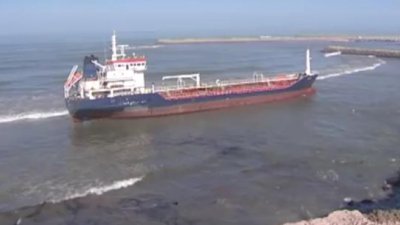
A new oil tanker accident at sea, in this case in the Moroccan coast of Tan Tan, has raised alarms in Morocco due to the possibility of a major oil spill. After learning about the accident, the Cabildo of Lanzarote has sent a letter to the Moroccan authorities requesting detailed information about the accident of the ship, coming from the Port of La Luz in Las Palmas de Gran Canaria, which transports more than 5,000 tons of fuel.
The causes of the accident are not yet determined, but the first reports point to the poor weather conditions that have affected the area in recent days. Winds of more than 90 kilometers per hour could have caused the ship to drift until it ran aground on the Moroccan coast and in the immediate vicinity of the port, according to the Cabildo.
From the first island institution, they have indicated that around 2:15 p.m. this Thursday there was evidence that the grounding area "is affected by hydrocarbon contamination", but the amount of fuel spilled, its evolution, and the measures taken by Morocco to deal with the spill are unknown. The Global Action Office has recalled that adverse weather conditions represent "a serious aggravating factor in this type of accident", since crude oil containment measures on the marine environment are much more complicated in case of strong waves and wind.
For this reason, the Cabildo of Lanzarote has sent a letter to the Consul General of Morocco in Las Palmas de Gran Canaria, Ahmed Moussa, requesting an estimate of the oil spilled into the sea in tons, as well as the oceanic surface covered by the contamination to date and time.
In addition, it has requested a description of the containment measures and the monitoring of the contamination adopted by the Moroccan authorities, as well as the name and registration number of the damaged ship and the possibility that Morocco requires technological and logistical support to deal with the contamination.
The Cabildo has also requested a confirmation and guarantee from the competent Moroccan authority that the contamination produced in this accident "is under absolute control in the affected area, and that there is no risk of extension in the marine environment that could affect the Canary Islands." When the Moroccan authorities provide information about the ship, significant data about it will be known, such as the flag and registration, nature of the shipowner and crew, company for which it operates, type of crude oil it transports, latest revisions and discharges, insurance company and, especially, if it complies with European regulations regarding the transport of hydrocarbons, security measures or double hull, among others.
Precedents
It is not the first time that an oil tanker has suffered an accident on the Moroccan coast off the Canary Islands. As the Cabildo recalled, on December 19, 1989, the Iranian oil tanker "Khark 5", heading to Rotterdam, suffered a strong explosion and a subsequent fire while sailing about 400 kilometers north of Lanzarote. Four of the cargo tanks burst and more than 70,000 tons of oil were spilled into the ocean, a quarter of the crude oil it was carrying and a quantity very close to that spilled in 2002 by the Prestige oil tanker in Galicia.
On that occasion, both the Moroccan and Spanish authorities refused to intervene on the ship because they understood that it represented a very high risk for their coastal coastlines and, therefore, despite the fact that for several weeks they tried to locate a refuge where to tow the oil tanker, the ship continued in the sea spilling an estimated average of 200 tons per hour, according to the Cabildo of Lanzarote through a statement.
This serious accident "highlighted the absence of contingency and response plans in the face of disasters of this magnitude, both from the point of view of policies on the designation of pre-established shelters, as well as international cooperation, as well as interventions on crude oil to try to contain it in the marine environment, something that is never fully achieved", according to the same sources.
In 1990, military flights from the Canary Islands approached the affected area to monitor the evolution of the spill and determine the risk that it could generate for the islands, since the crude oil did reach the beaches of Casablanca and other coastal areas of Morocco.
Increase in oil tanker traffic
On the other hand, the Global Action Office has warned about the increase in oil tanker traffic that the Canary Islands will experience "in the event that the exploitation of the alleged oil deposits is carried out by Repsol, by increasing the degree of risk of accidents and spills at sea." Since 2005, the International Maritime Organization (IMO) declared the marine environment of the Canary Islands as a "Specially Sensitive Maritime Zone", a United Nations figure aimed at preventing hydrocarbon pollution in areas of great biodiversity.
According to the Cabildo, the area approved by Spain for Repsol to explore the seabed in search of oil not only coincides in part with the area declared by the IMO, but also occupies about 50 percent of the area of the Site of Community Interest (SCI) proposed by the Indemares Program for the marine environment of Lanzarote and Fuerteventura (financed by the European Union and managed by the Biodiversity Foundation and the Spanish Ministry of the Environment).
Add La Voz de Lanzarote as a preferred Google source.
Stay informed with the latest current news.