
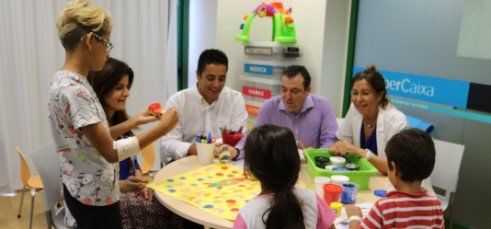
The Doctor José Molina Orosa Hospital in Lanzarote has received several copies of the book 150 games to have fun inside and outside the hospital, an action promoted by the Atresmedia Foundation. Thus, as the first activity of those marked in the publication, the children who are admitted to the Pediatrics ward of the hospital center decided to "launch a rocket into space from a cardboard".
"The launch of the rocket was controlled by the director of the Lanzarote Health Area, José Brito; the manager of the island's Health Services, José Luis Aparicio; the head of the hospital classroom; Mónica Alonso; the head of the Pediatrics service, Concepción Pérez, and some relatives of the children who receive care at the center", they point out from the Ministry of Health.
The Atresmedia Foundation, an organization that has been collaborating with the Doctor Molina Orosa Hospital for years and that has promoted the publication of this work, has donated several copies, an action that it has repeated in another 163 hospitals throughout the country.
The book 150 games to have fun inside and outside the hospital, written by the journalist Lary León and published by Zenith, includes challenges to develop the imagination, to make you laugh, to relax, to express emotions through music and sounds and to promote skills with numbers and words.
The author of the work, Lary León, explains that "children in the hospital are sick, but they are still children and need to play, laugh, learn, see colors, feel joy around them and, above all, they need emotional attention." She is clear that playing is "one of the best gifts that can be given to them, giving them the ability to cheer themselves up, to have a positive attitude in the face of adversity." It is about enhancing self-esteem, that of children and that of adults, to discover together how valuable it is to put empathy into practice and cultivate patience, essential in a hospital.
The author's rights and part of the profits of 150 games to have fun inside and outside the hospital will be entirely allocated to the Hospital Assistance Program of the Atresmedia Foundation, which aims to promote the humanization of children's hospitals, developing actions aimed at both informing children about the process they are going through and entertaining them.
Hospital educational coverage
The hospital classroom of the Doctor José Molina Orosa Hospital in Lanzarote provides educational coverage to boys and girls between 3 and 14 years old admitted to the center. The average length of stay of these minors is four days and the number of small patients who attend the classroom each month is between 16 and 20, according to the Ministry.
This device is mainly constituted by two spaces: a cyber classroom and a school. This classroom is an authentic "unitary school" with special characteristics, which aims to promote integration and compensatory education. "The service has a high level of satisfaction, both on the part of the staff attached to the hospital center, and on the part of the families of the patients," they assure.
The teacher responsible for the classroom carries out communication and relationship activities with the children, and seeks to foster an environment based on relationships of trust and security, while bringing the hospital classroom closer to all those who make up the natural environment of these children: family, nurses and assistants, through the exchange of letters, messages and drawings with classmates and with student-patients from other hospital classrooms.
Hospital Classrooms are considered as a particularly significant part of the therapeutic community, with the task of alleviating the addition of dysfunctions typical of the stimulating depression that is generated with hospitalization, especially in young patients. The response seeks to minimize the trauma of being separated from external stimuli and from the relationship with objects normally present in the respective school and home environments.


