
The new representative of the UN Refugee Agency (UNHCR) in Spain, Grainne O'Hara, is asking this country to establish more legal and safe routes for migrants - especially labor routes - to prevent many from being forced to make dangerous journeys, which in many cases end with their lives.
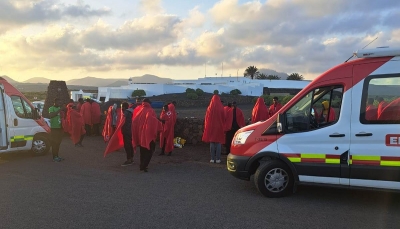
The highest authority of the international organization in Spain, who took over from Sophie Muller last November, referred to the Canary route in an interview with the EFE Agency, considered one of the most dangerous in the world.
A total of 46,843 migrants arrived in Spain via this route last year, according to data from the Ministry of the Interior, and 9,757 died trying, according to the count carried out by the NGO Caminando Fronteras.
Faced with this humanitarian challenge, Grainne O'Hara argues that, since Spain has a national policy that recognizes the need to incorporate migrant workers into its labor market, it should seek appropriate legal channels to offer this possibility to people who have "qualifications and skills" to work in Spain.
All this as an alternative to "dangerous journeys, carried out irregularly, many of which unfortunately end in the loss of lives."
"It cannot be that the only ways some people see to reach a point of safety is in the hands of criminals who are exploiting them, stealing money and abusing people's trust, there must be more legal ways," she demands.
In this sense, she positively values that Spain has some of these alternatives for refugees, such as resettlement or the possibility of applying for asylum from a third country through embassies.
But she assures that they are not enough for the demand that exists, since, in the first case, it is a limited number of places - 1,200 for 2025 - and the embassy route only works for very specific circumstances, such as family reunification.
A pressured but not collapsed asylum system
The asylum system in Spain is the third that receives the most requests from the European Union and presents serious problems to access it - it is very difficult to get an appointment - and to obtain a response: according to the Spanish Commission for Refugee Aid (CEAR), there are more than 242,000 applications pending resolution.
Asked about these barriers, O'Hara argues that the Spanish asylum system has "pressures" because "there is more demand than capacity" and a "bottleneck" is formed when dealing with applications, but denies that one can speak of "collapse."
And she emphasizes that the UNHCR personnel present in territories such as the Canary Islands or Ceuta work "hand in hand" with the Police, the Government and other actors involved in their "effort" to prioritize the most urgent cases, with the aim of resolving them as quickly as possible.
Entities such as CEAR also question the low rate of recognition of international protection in Spain, of 18.5% compared to an average of 42% in the EU, taking into account refugee and subsidiary protection statuses, the most guaranteeing ones.
However, O'Hara considers that the "complex" Spanish asylum system manages, through various figures - refugee status, subsidiary protection, authorization for humanitarian reasons and temporary protection - to meet the "needs, hopes and urgencies" of a "huge variety of nationalities."
Possible adverse effects of the new immigration regulations
Last November, the Government approved new immigration regulations that will make it easier for foreigners living in Spain to obtain papers through the arraigo mechanism.
But it also establishes that the time a person has spent in Spain waiting for their application for international protection to be resolved will not count as a period of residence when applying for arraigo, a measure that seeks to clear the asylum system for those who really need it and that has led NGOs such as Cáritas or CEAR to appeal the regulations before the Supreme Court.
Regarding these possible adverse effects, O'Hara has indicated that Acnur is still unaware of the details of the application of the text, which will come into force on May 20, so she has asked to meet with the entities to understand their concerns.
In any case, the representative believes that this new framework may have a "positive impact" on many people - the Government estimates that it will allow the regularization of some 900,000 people in three years - due to its strengthening of the arraigo mechanism, which, she stresses, "is not offered in all European countries."
"We hope that these regulations may also have a positive effect, in the sense that perhaps it serves the needs of a certain profile and of people who should not or do not need to be in the asylum system," she says.
No fear of the European migration pact
The European migration pact, approved last year, must be implemented in Spain by the summer of 2026, which will mean major changes in the legislative framework on immigration and asylum, and NGOs fear that this will translate into a setback in the rights of migrants and applicants for international protection.
In this regard, the UNHCR representative in Spain has valued this pact, "complex and ambitious", reached after several years of negotiation with the aim of achieving greater homogeneity throughout the EU, with "comparable systems" and "minimum standards".
"But each country has, within its sovereignty, the possibility of determining how it will handle the details of its national asylum system and the current Spanish policy is quite inclusive, generous and positive... I am not so afraid that, just because the pact exists, (the system) will be more closed or the standards will be stricter, because each country has some flexibility," she analyzes.


