
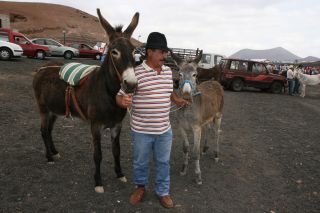
". It is small, furry, soft; so soft on the outside, that it would be said to be all cotton, that it has no bones. Only the jet mirrors of his eyes are as hard as two black crystal beetles." Juan Ramón Jiménez described Platero, the donkey protagonist of one of his stories, but these hallmarks could belong to Luisita and her baby Modestita, to Galicanto or to Patera. They do not graze in the meadows recreated by the Andalusian Nobel Prize winner, but trot through the sandy lands of Lanzarote, as their parents and hundreds of specimens of their species did for centuries, faithful companions of the farmer from Lanzarote.
With their saddlebags loaded to the brim, leveling the picón and removing weeds or with the dragging threshing board, the donkeys were an indispensable element for the crops to go ahead. The engine entered with force in the Lanzarote countryside and the donkeys, with their calm gallop and their bowed heads, were disappearing from the agricultural scene on the island. Now the specimens that remain "have gone to a better life", because far from being lost in the oblivion of abandonment, as has happened in other parts of the Spanish geography, in Lanzarote the donkeys walk alone or with their owner on their backs, eat and, in some cases, continue to help in the field, as they have done all their lives.
Patera does help her owner in the field. From time to time "I take her to scrape some sandy patch that I don't have access to with a tractor." Ricardo Morales says this while holding the donkey's rein with one hand and the puppy with the other, who doesn't take it off even galloping on Patera's back. He is eight years old and has a name with a story behind it, that of 17 people who lost their lives at sea in an attempt to reach the coast of Fuerteventura embarked on a patera. "They drowned the same day she was born" and this is the particular tribute of Ricardo and his wife, Margot.
Patera, according to her owner, is a donkey of the Canarian breed, "what in Fuerteventura they have registered as a Majorero donkey", he clarifies. She lives in the countryside, on a farm located in Tinajo next to three other donkeys, one of them a few months old. Their specimens are native, differentiated from other breeds by their features, "they are shorter, the ears and the head are different, but ours have more blood".
And it is that in Lanzarote it is already easy to see another type of donkeys that have crossed half of Europe and part of the Atlantic Ocean until stopping in the land of volcanoes. They are the donkeys brought from Romania by initiative of the Cabildo of Lanzarote three years ago, in order to give them to the farmers who had requested them. A measure that has not been well received by all. "They brought 26 specimens to Lanzarote by boat, which posed a serious danger to the conservation of the native breed, in danger of extinction", explains Antonio Cabrera, one of the founders of the Group for the Conservation and Promotion of the Majorero Donkey "Soo", dedicated to the identification and protection of this breed, which according to the latest analyses carried out by the association and the Autonomous University of Barcelona, comes from North Africa.
But to those who love this animal in Lanzarote, so often reviled for its supposed lack of intelligence, the origin of the specimens is not what matters most. "We are more concerned that the donkey population grows, we don't care where they come from, although we keep the native breed located", says Ricardo Morales.
The little donkeys of Tinajo
The donkeys stopped being used in Lanzarote towards the end of the 70s, "when everyone started to put the Land Rover in the fields" recalls Ricardo Morales, and the donkey "started to be a nuisance". Today it is not cheap to maintain them because bastos, saddlebags, harnesses and any other object for their rigging, has become almost a luxury item. There are few people who are dedicated to this type of work and "they are already very old", explains the farmer, so their work, one hundred percent handmade, is expensive.
Today, no one knows exactly the number of donkeys that live in Lanzarote. Manuel Arbelo, a cattleman from Tinajo, believes that in the municipality there are approximately 25 donkeys, to which are added other specimens from the rest of the municipalities. On his farm located between Soo and el Cuchillo live peacefully five specimens. "Luisita, who is the mother of Modestita, the youngest; Gorrona, Galicanto who is the male and Española, this one is called that because she came by boat from the Peninsula". Manuel Arbelo speaks with affection of all his donkeys. He has them as a hobby "to take a little walk?they live better than me" he smiles.
Arbelo and other farmers and ranchers in the area intend to form an association for the conservation of the donkey and in the Town Hall of Tinajo, they are delighted with the initiative. They consider that this animal represents a sign of identity for the municipality, "by tradition they call us the donkeys", recognizes between laughs the councilman Aquilino Romero, but also they can become a gold mine for tourists. Romero is in favor of delimiting a donkey route to climb the volcano of Caldera Blanca, "we have some very beautiful volcanoes and it would be a good idea". For the moment, their owners will make, on the backs of their donkeys, the pilgrimage route that takes them to the hermitage of Los Dolores next Saturday, to return again with their soft trot to their peaceful lives in the sandy lands of Lanzarote.
Arre borriquito, arre!
They are determined that the donkeys will once again occupy their place in Lanzarote life and their space in popular festivals. That is why the residents of Tinajo organized on Sunday, September 16, on the occasion of the Los Dolores festivities, a gymkhana in which the protagonists were the donkeys and their owners, who in pairs had to complete five tests, for which it was necessary, above all, a good dose of humor.
Taking a candy with the mouth from a basin of gofio, eating some custard blindly or bursting a balloon with the chest, were some of the obstacles that the participants had to overcome, while their faithful donkeys waited to be ridden again.
Twelve donkeys participated in the gymkhana promoted by the farmers and ranchers who take care of their donkeys and who refuse to let them fall into oblivion, who also had the collaboration of the City Council of Tinajo. Esperanza in third place ridden by Onofre and Pili, Filomena as runner-up with Luis and Renata and Pepa in first position carrying on her back Toño and Sara, left in good place Leandro de León, a farmer from Tinajo owner of the three winning donkeys, which in addition to being fast are hardworking: they help Leandro to get his strawberry crops forward. Laughter and good humor were not lacking in this particular competition.


