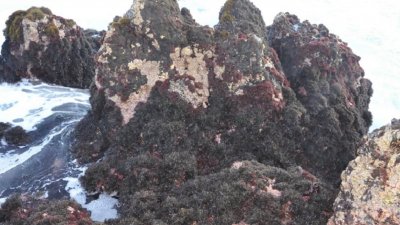
The University of La Laguna has announced that it is working to save the red gelidial algae (Gelidium canariense), an endemic algae especially vulnerable to the threat of climate change. The public university states that the marine biodiversity of the Canary Islands is at risk due to its "sharp decline".
These algae are fundamental for the health of coastal ecosystems and for absorbing carbon. It is the only endemic macroalga of the Canary Islands that is in danger of extinction due to climate change, and that is only found in cold and shaded areas of northern La Palma, La Gomera, Tenerife, and Gran Canaria.
To curb this loss, the University of La Laguna, with funding from the Biodiversity Foundation and the European Regional Development Fund (ERDF), has launched the Gelirock Project (Declining biodiversity refuges: characterization of priority areas for the conservation of the gelidial community in the Canary Islands), led by researcher José Carlos Hernández, and which has the participation of professor Rocío Pérez, from the University of Barcelona.
A budget of more than 500,000 euros
This initiative, with a budget of 501,000 euros and which will be carried out until the end of 2028, aims to evaluate its current state, map the distribution of the community and its populations and identify priority areas for its conservation and restoration, with the aim of promoting specific protection measures on the Canarian coast.
Hernández highlights the historical importance of the Gelidium canariense. “In the north of Tenerife, especially in Puerto de la Cruz, this species was collected for agar extraction because there were large strandings, accumulations of algae on the coast, and it possesses the typical smell that exists in these places,” he points out.
In addition to its cultural value, the algae fulfills a crucial ecological function: “We have located more than 200 species of microinvertebrates that live in these places, spectacular specimens,” among which are included some new species for the Canary Islands that live exclusively in these sites. These species act as buildings where these small invertebrates live, so, points out the researcher, their loss would mean breaking the food chain and would affect fishing activity and marine biodiversity in different areas of the Canary Islands.
The evolution of the species subject of the project that now begins has been analyzed during the last years by these specialists. A study carried out by researchers from the research groups Marine Community Ecology and Conservation and Marine Botany of the University of La Laguna, published in the journal Regional Environmental Change, confirmed that more than 90% of the populations of Gelidium canariense has disappeared from the north coast of Tenerife during the last years. The research compared historical data from 1987 with records from 2008 and 2019 and showed that the decrease of this species correlates directly with the increase in sea and air surface temperature and ultraviolet radiation.
In turn, the publication revealed that the areas where the species Gelidium canariense previously predominated are now affected by the proliferation of Pterocladiella capillacea, a species of global distribution and more resistant to the new climatic conditions. The researchers also found that the coverage of Gelidium arbuscula has also significantly decreased, while the community dominated by the endemic Gelidium canariense has fragmented, affecting the entire trophic structure that depends on it.
The GELIROCK Project will combine various scientific tools, such as climatic maps, satellite data, and oceanographic buoys to address this crisis and evaluate the conditions that favor the survival of these algae. Furthermore, using novel population genetics techniques, the researchers will study the genetic diversity of Gelidium canariense and the connectivity between populations, thus identifying the most important areas for its conservation.
Hernández compares the disappearance of these algae with what is happening in the Amazon rainforest: “Not only are we losing one of the planet's lungs, species that we haven't even gotten to discover are disappearing, and that is happening in the Canary Islands underwater,” he warns.
The project also seeks to identify possible climate refugia by analyzing the historical environmental conditions in the areas where these communities still survive. In this way, it will be possible to understand how they have evolved in relation to variables linked to climate change such as the increase in temperature or ultraviolet radiation.


Add La Voz de Lanzarote as a preferred Google source.
Stay informed with the latest current news.