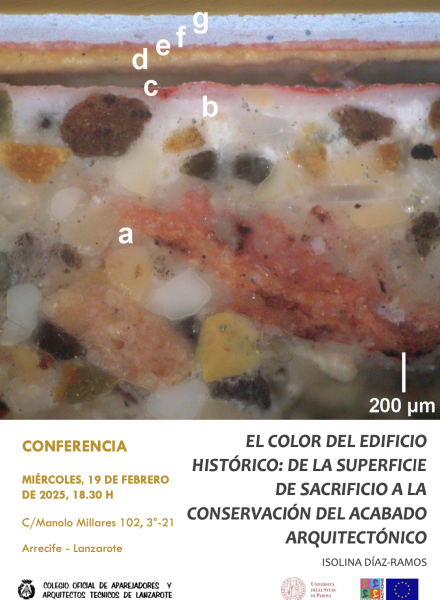
Isolina Díaz, a researcher at the Italian University of Padua and also an art restorer, has given an interview to La Voz on the occasion of her visit this coming Wednesday, February 19, to the headquarters of the Association of Quantity Surveyors and Technical Architects of Lanzarote. Under the presentation The color of the historic building: from the sacrificial surface to the conservation of the architectural finish, the expert will review at 6:30 p.m. the chromatic evolution of the historical facades of the archipelago and the importance of preservation.
"I like to think that the city I am walking on has something to do with the city my great-grandfather saw," she confesses. Her great-grandfather was an emigrant, he left for Cuba and was never able to return to his native Gran Canaria. This researcher highlights the value of historic cities in the cultural heritage of the archipelago and the ties that bind natives to their ancestors. "Being in a space that I share emotionally, that I know that my mother, my grandmother, or my great-grandmother stepped on, that we have those common territories," she indicates.
To find out what the streets and buildings were like two centuries ago, Isolina Díaz studies the pigments of the facades. "When I talk about a certain pigment that was applied, which is no longer used, for example, lead white, I start to go genealogically backwards and I am discovering the color that my great-great-grandfather saw, who lived in 1800," she explains. "It is an identity issue, of our identity, which is always very connected with the local, but with a lot of exchange of what comes from outside. It is a bit of a reflection of what a Canarian is," she continues.
Isolina Díaz, a doctor from the University of Las Palmas de Gran Canaria, who obtained the prestigious Marie Curie grant, has been researching the facades of three historical centers of Gran Canaria, Vegueta, Triana and Santa María de Guía, for three years. To do this, she has worked with buildings from the 16th century to the 20th century. "We are seeing an evolution of the materials that were used in the construction of the color of the facades corresponding to fashions, the materials that were marketed in each era, etcetera," she narrates.
These pigments are studied together with the architectural finish. The traditional Canarian buildings started with mud in the first ones, passing through lime and sand mortars, until ending with cement ones, "which are the ones that are used today." The lime that was used in the historical buildings of Gran Canaria came from Lanzarote.
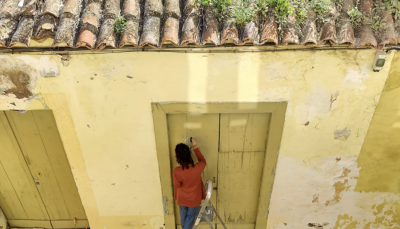
With this work, Isolina Díaz seeks to "value all the traditional architecture, the traditional materials, in order to know how to face a restoration that will not generate problems for the future." For example, when scraping layers of historical buildings, you can see how those built in the 18th and 19th centuries show ocher or reddish tones. "The buildings of these centuries were all painted with colors," she explains.
To conclude, this researcher states that her work pursues "to value this element, because it gives a lot of information, not only about your aesthetic taste, but also about the purchasing power of the people, the materials that were local, the materials that came from outside."