
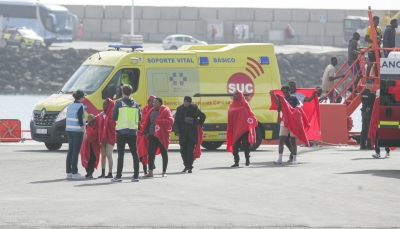
The Ombudsman, Ángel Gabilondo, has pointed out in his 2025 report that people who are detained in temporary foreign care centers (CATE), such as the one in Arrecife, must be able to keep their mobile phone or have the option to make a call to communicate with their lawyers or inform their relatives that they are alive.
These centers are spaces where people arriving by dinghy to Lanzarote, to other islands of the archipelago or to other border cities are guarded by the National Police. During the first 48 hours they are held while an administrative file is opened for each of them. This file will determine if they have the right to remain in the country under the assumptions collected in the law or if their return is ordered.
The aforementioned report states that from the beginning of their detention their mobile phone is taken away and they are left without the possibility of making a call until they leave the center. "These measures make contact with the outside impossible, generating unnecessary suffering for foreign individuals and their family and friends, who cannot know that they have reached solid ground", the Ombudsman has highlighted.
The Canary route is the deadliest migratory route in Spain and one of the deadliest on the planet. In total, throughout 2025 five boats disappeared with all the people traveling inside them. The reinforcement of controls to prevent the departure of boats from the Moroccan coast and the Western Sahara occupied by Morocco means that boats increasingly have to depart from more distant areas and, therefore, more dangerous, as the journeys are longer.
A visit without communicating but without foreigners
In September 2025, the director and a technician from the National Mechanism for the Prevention of Torture (MNP) made an unannounced visit to the facilities for the initial reception of foreign persons that the Government of Spain has in Arrecife. During their stay on the island, they visited the temporary foreign care center located next to the National Police station and the facilities in Puerto Naos. During that visit, there were no foreign persons detained in the CATE and they only interviewed several National Police officers.
It should be remembered that in February of this year a trial was held in the Provincial Court of Las Palmas where an officer was tried of the National Police accused of torturing two migrant people at the CATE of Arrecife in January 2024. The case was adjourned for sentencing.
In another point, Gabilondo has pointed out "the difficulties" that the agents of the National Police who guard these spaces face. Thus, he has indicated that the police officers must guarantee that the guarded persons receive a "humanitarian attention", since in most occasions they come from a "painful" journey in numerous groups, at the same time that they guard the group and investigate the possible crimes that may exist.
At the same time, the Ombudsman has recalled the importance that these centers have furniture and belongings in good condition and has highlighted that it is "unacceptable" that people sleep on the floor. In addition to with outdoor spaces and sonas of shade to shelter from the sun.


