
Next to the sea on Avenida de Naos is the Maritime Fishing School of the Canary Islands. There, students of Compulsory Secondary Education (ESO) mix with those who attend cycles and courses of maritime education. Some of the latter live in the residence that is on the same site, which they access through a grant from the Government of the Canary Islands. Francisco Miguel, a 34-year-old fisherman from La Palma, lives there, studying a Local Fishing Skipper course that lasts about two and a half months.
He has been dedicated to fishing since he was 15 years old due to family tradition. His father was a skipper "he has always liked the sea, he has passed that on to us and we have to follow the tradition because we like it too". Although he loves it, he recognizes that fishing is hard, "you have to put in many hours to catch fish and right now, fish is also becoming scarce". However, he dreams of having his own boat and once he finishes the course and enlists for 18 months, he intends to buy his own boat. "For the moment I am happy with my course, with the illusion of getting it".
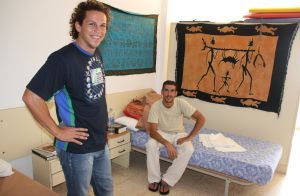
In the corridors of the residence where Francisco Miguel is staying, Juan returns to his room. This 30-year-old born in Rosario (Argentina) arrived about four weeks ago from Ibiza to study the higher-level training cycle in Navigation, Fishing and Maritime Transport. He shares a room with Pedro, another student of the Maritime Fishing School. Pedro is from Vigo, but his residence before arriving in Lanzarote was in Fuerteventura. "I'm burned out from the hospitality industry and I want my hobby to become a profession," he says. Both have always maintained contact with the sea at a sporting level and comment that the exit that interests them most from their studies is tourism, sailing on boats dedicated to this sector. They are also excited about both the residence, since they do not have to take care of paying rent or paying for food because they are on scholarships, and the planned departure on the school boat called La Bocaina. "It's like going back to youth," says Pedro.
Pedro has four years ahead of him. And, as the director of the Maritime Fishing School, Fernando Camacho, says, "if you study a hairdresser training cycle, you finish the cycle, and you can already cut hair, in this training you finish and you can't do anything". He says that once the studies are finished, those who want to be coastal skippers (passenger), for example, the Maritime Authority requires them to have two years as sailors and several certificates. Thus, Fernando highlights that one of the advantages of the school is that the students, while studying, obtain all the certificates that they will be asked for in the future, in order to "save money and time".
Maritime exits
According to Fernando, the jobs of a coastal or fishing boat are usually the main exits from maritime courses and cycles.
Although fishing is declining, there are students who stay working in the fishing sector, since "there is demand because there are no professionals". Fernando says that "we are losing tuna boats, since 1990, since from the thirty tuna boats we have gone to below ten, but fishing still exists, although the meters of the fishing boat are smaller". For the director of the school "people who like fishing end up on artisanal boats". Although he also indicates that others have started working for companies such as Pescanova or Calvo, "which are boats that go to hake? in extreme conditions".
Regarding the other exit, that of coastal shipping, he says that it is not the same as fishing, "you have to like fishing, coastal shipping is different". Fernando comments that the passage is not so hard; "A bus arrives at the dock with the workers who get on board the boat and take a maritime excursion, returning later to the dock so that everyone sleeps in their house, while, on the fishing boat you can be 7, 10 or 12 days at sea".
The machine ones
In addition to the maritime courses, those that focus on the maintenance of the facilities of the ships are also taught and Alma, a 19-year-old from Máguez, is the only female in her class who receives this type of lessons. She doesn't have a way to go back and forth to her town every day, so she stays in the residence. When she finishes the cycle she has a range of possibilities open, "I would like to embark or continue studying; go to the University or do the higher one in machines".
Regarding the exits of this course, Fernando points out that "they are more on land than at sea, because Unelco and Inalsa demand many professionals, since their engines are exactly the same as those of a boat". The director of the school indicates that "many of those who sail, when they decide to disembark, stay working in an apartment complex as maintenance managers".
In fact, some of the students do not even consider working at sea. This is the case of Xabi and Eneko, two Basques from Usurbil (Guipúzcoa) aged 23 and 25 respectively, who share a table in the residence's dining room before going to the higher machine classes. They had been working in the production sector for several years and were already "bored", so they decided to come to the island "to leave home" and "try" in this sector.
In short, the Maritime Fishing School welcomes more than 100 students in its training cycles, from the Canary Islands, various points of the peninsula and even foreigners, who have started a course in which they will be linked to the sea or the machinery of the boats that sail in it.
Adapting to the new times
"We have been adapting to the new times" says the director of the Maritime Fishing School, Fernando Camacho. They have had to introduce many novelties, since everything changes. Thus, Fernando comments that currently, coastal boats are smaller, that auxiliary boats, coastal boats for tourism and the aquaculture sector appeared, among many other things. For this reason, they have had to adapt the school with simulators, new technologies and facilities. "We have been investing money in the school for almost 12 years". Currently, two higher-level cycles and four medium-level cycles are taught, in addition to maritime training courses such as fishing captain or local fishing skipper.
He gives a 10 to the facilities of the center he directs, which has, among other things, a planetarium where students learn to navigate at sea through the stars, a physics laboratory, two others for chemistry and biology, a 30-meter pool for underwater immersions, a marine crop plant, a multitude of simulators, a school ship called La Bocaina, 30 meters long and a 15-meter sailing yacht, the Goana, which according to the center's concierge was a donation made to the school, after it was seized from a drug trafficker.


