
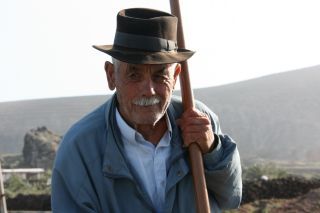
In the fields surrounding the town of Órzola, it is easy to find his figure, somewhat hunched over by the years, his head protected from the sun and wind by his inseparable puppy and leaning on the staff that identifies him as a shepherd, near the eight goats he still keeps "for the vice of having them" as he explains. For the town's residents who pass by, there is no doubt, it is Domingo de León Dorta, the poet of Órzola.
Although he doesn't like this nickname. "I never say I'm a poet, because even if I know something, I don't like to talk about it". Pure modesty to avoid acknowledging what the conversation reveals on its own: the rhymes that he gradually gets encouraged to release.
Domingo de León Dorta is one of the few improvisers on the island. An art practiced by a few capable of composing verses, rhymes, and songs in a moment, linking the Canary Islands with Cuba, two places where improvisation has roots and is practiced. But all of that sounds like Chinese to him. "In Cuba? I don't know, I haven't been to Cuba and I don't know what it's like", he explains logically.
For Domingo, this thing of making verses and rhymes while talking is an ability "that comes just because" he says. "This cannot be bought or sold, and it cannot be taught either", he says, leaning on his inseparable staff. "Do you write them down?", and Domingo cannot help but laugh at the question. "Write? I can't read or write. They are in my memory, they don't leave from there," he assures, pointing to his head with a wrinkled index finger.
Domingo doesn't remember there being a school or teachers in the town when he was a child to learn the main rules of grammar, but that hasn't stopped him from being a poet. "I don't know how to read because they didn't teach me, but God gave me memory so I could improvise", he blurts out. First rhyme of the afternoon and it won't be the only one.
Throughout his life, Domingo has made numerous rhymes that he has in his head but that over time, will be lost if they are not written down, and he knows this well because everyone tells him so. "You should write that down, it's a memory, they tell me, if I knew how, I would have them all written down," the improviser assures. For now, one of his daughters is in charge of writing some in a notebook, it's a start.
His inspiration: the people and the Virgin of Sorrows
He says he doesn't know where this hobby comes from. Maybe from an older cousin who is also a good improviser, he says, or from an "old man" he met many years ago who told him what he was improvising. The fact is that he doesn't remember what the first improvised poem he made was, but he does remember the last verses he has invented while sitting and watching the goats look for something to take to their mouths.
"I started wearing shoes when I went to the barracks / but today they buy them before they are born. / And they are furry little shoes that won't bother them / so they don't get sores when they walk". Between verse and verse, he lets out a laugh and looks away to recite them, because Domingo, at 79 years old, is very shy. He says that these are a few words that he has put together inspired by "the cases that they tell you and from which you can get a rhyme" and specifically by how much society and the family have changed. "Today, even before they are born, they buy clothes for children and that, it didn't happen before", he explains.
And the poet of Órzola knows this well, he already has five grandchildren from the three children he has had with Felisa Álvarez, who has been his wife for 46 years, and he admits that he still hasn't made any poetry for her. "For my grandchildren, yes" he defends. And it is precisely one of his grandchildren who seems to be going down the same path as his grandfather because at only 10 years old he is already able to go on stage and recite the rhymes that he has previously written from his grandfather's mouth.
Another of his sources of inspiration is the Virgin of Sorrows and that is why he has gone to the hermitage of Mancha Blanca for many years to tell her poems, but now he admits that it is more difficult for him to compose them because he believes that to do so "you have to have humor and joy, but one is already losing it? at the same time that one cannot walk well, well, it cannot be the same". But the truth is that Domingo still retains the humor and joy to which he refers because he does not hesitate to recite a curious composition shortly after.
"Which is also a story I learned a long time ago / that between the bride and groom it is a coincidence / that their faults are known
while in good friendship. / Everything seems like flowers to them and it turns into humility / and in the middle of the loves they hide the falsehood. / But then the day they get married, it is not immediately noticeable / you have to see them enjoying spending a happy life / enjoying satisfactions that they did not have before. / But then the day comes when they throw the plates / that the years take us like dogs and cats".
He is used to reciting his compositions in public because he does it every year at the Santa Rosa festivities in his town, when he can in Tinajo, and this year he also did it at the San Juan de Haría festivities where he was also recognized by the City Council. There, he says, he received more applause than he expected. "I was amazed when I went out there, they laughed as much as they wanted". And although Domingo doesn't like to tell his compositions in public too much and be known for his art of rhyming words, he is still the poet of Órzola for his neighbors.
Poetry to the Virgin of Sorrows
(...) The Hermitage of Sorrows
is in the town of Mancha Blanca
and I will not forget this
as long as my memory holds.
There is the house of the Virgin,
there she is night and day
that I always remember her
and I would never forget her.
I can't walk anymore
and the jobs are for me,
this was a coincidence
that I could get here.
Even if I can't walk
she is already seeing me here
accompanying the Virgin
and she gives me relief.
It had been a few years
since I had been here
and I was always remembering,
someday I have to go.
Today the Virgin will tell me
and she tells me with reason,
Where have you been
that I haven't seen you?.
I hadn't come
because I couldn't come
but if you wanted to see me
today you have me here.
And I come with joy
and there is no falsehood here,
I come to tell you a poem
that I am going to improvise.
When you came down from the temple
and passed by the altar,
even the stones in the street
here were seen to tremble.
You have been miraculous,
you already showed it
because you stopped the fire
when the volcano burst.
When the volcano burst
there in the middle you were,
but you with your power
the fire was retreating.
There you spread your mantle
and the lava was retained
and in the town of Mancha Blanca
your face shone.
When you saw yourself alone
no one looked at you
now when they need you
everyone acclaims for you.
If you continue with your customs
company will not be lacking
and here every day
they come to pray to you.
My Mother of Sorrows,
if someday I leave here
don't forget me.
Always remember me
that I came to improvise for you.
Goodbye Virgin of Sorrows
I say goodbye to you,
I'm going to the orchard up there
to the town where I was born.


