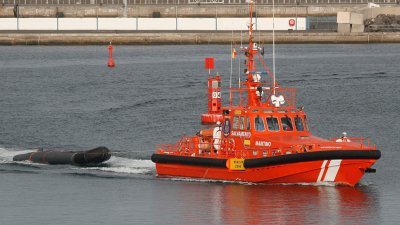
Despite the upward trend of arrivals to the Canary Islands via precarious boats in recent years, which accounts for 74% of migrant entries by sea to Spain, October has been an atypical month and marked a decrease of 36.5% compared to September and a drop of 1,050% compared to the same period last year. This is according to official data at the close of the month, as reported by La Voz.
The decrease in October occurred in crossings to the eastern islands, with Fuerteventura down 84% and Lanzarote down 79.7%. Between the two islands, arrivals decreased by 1,700 people in the tenth month of the year.
Despite this, the trend continued upward in the western islands, although the drop in Lanzarote and Fuerteventura has significantly reduced the trend. Thus, the province of Santa Cruz de Tenerife received 77.28% of migrant arrivals in October, with the majority concentrated in El Hierro, a total of 2,230 people in 22 boats.
Political, social, and environmental phenomena in the countries of origin, as well as wars, influence the need for people to leave their birthplaces and seek new opportunities in Spain and Europe. However, the poor sea conditions "for most" of October have forced human traffickers to wait until November to plan departures.
In this sense, three out of ten departures (33.3%) of boats occurred from the coasts under Moroccan control, Morocco and Western Sahara, four out of ten (42.22%) from Mauritania, and two out of ten (24.4%) from the coasts of Senegal or Gambia.
In October, 93% of the people who arrived on the islands were of sub-Saharan origin, 5% of Maghrebi origin, generally from Morocco, and 2.08% from countries of Asian origin. In addition, the majority were men (88%), with women (6%) and minors (6%) being a minority on the route.
Changes in the migratory route to the Canary Islands
The presence of nationals from other countries, as is the case with migrants of Asian origin, could signify "the opening of new routes" for the transfer of people.
In addition, the rejection by Greece and Italy to allow access to both countries to migrants from the African continent through irregular channels could also modify current flows in the medium term and influence the migratory route to the Canary Islands.
Despite the restrictions in these two countries, the Central Mediterranean, with departures in Libya and arrivals in Italy and Greece, leads this year in the arrivals of migrants. In this way, the Mediterranean route concentrates 53,890 survivors so far this year; followed by the Eastern Mediterranean from the Middle Eastern countries to Turkey, with 52,237 arrivals.
Despite being only a group of islands, the migratory route to the Canary Islands is the third in the European Union in terms of arrival flow, with 34,162 so far this year. Far behind is the Western Mediterranean, with 12,069.



Add La Voz de Lanzarote as a preferred Google source.
Stay informed with the latest current news.