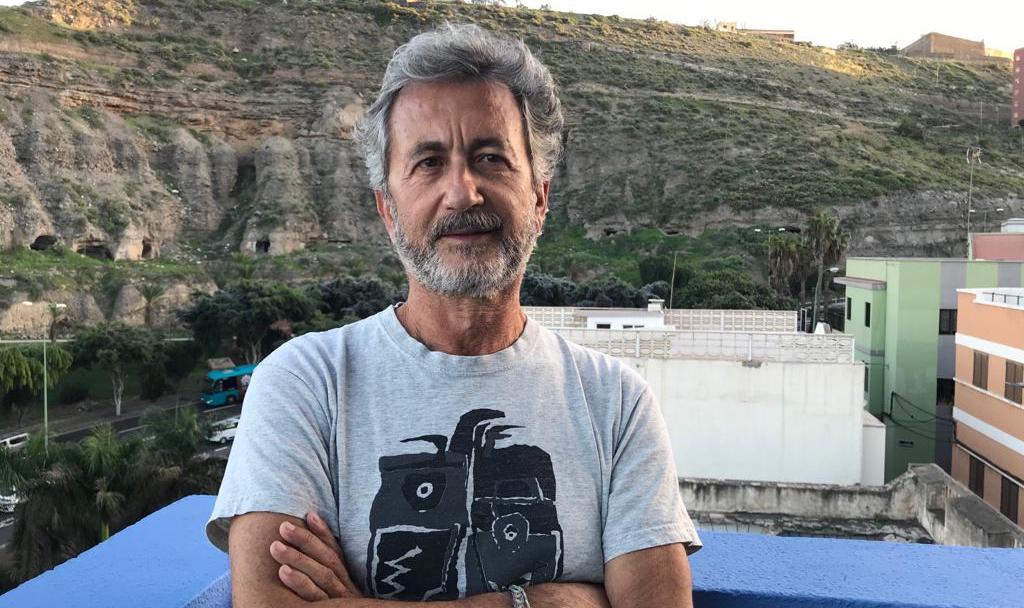
Retired professor and activist for the environmental conservation of Lanzarote, Miguel Ángel Robayna, has stated in an interview granted to Radio Lanzarote-Onda Cero that currently "it is believed that destroying historical heritage is modern, but that is not modernity or development."
The professional argues that, currently, the "cement policy" tries to establish this idea, but "it is essential to understand that taking care of the land is not only a right, but a human duty."
Saving Malpaís de la Corona
However, this reality stems from "a reckless speculative model" that has been perpetuated for several years.
Robayna participated in the origin of the environmentalist collective that, in 1981, led the Salvar Malpaís de la Corona movement: "In 1979 we formed a coordinator after learning that they intended to sell this area to turn it into a plot, and we began a fight for the inherited heritage", recalls the professional.
The Malpaís de la Corona encompasses two million square meters that go from Caletón Blanco to Los Jameos.
During this same time, "they intended to carry out other projects like this without conducting feasibility studies or anything like that, such as installing 20,000 tourist beds in La Graciosa, as many in Lobos, a tunnel in the cliff of Famara or a cable car between Lanzarote and La Graciosa", a fact that, as Robayna explains, "outraged many people."
Therefore, they demonstrated and managed to "get a large part of the population of Lanzarote out on the streets, and also people from other islands, where groups and institutions showed solidarity with us and understood that it was a common cause, because they wanted to turn all of the Canary Islands into a plot."
A "vitiated" and "reckless" policy
In this way, Robayna explains that they obtained the support not only of environmental groups from all over the archipelago, but also of institutions such as the University of La Laguna, political parties and even César Manrique: "We were united by the affection of our elders for the land, and for the sea, who cared for it as if it were their own life against the institutions that did not defend the interests of citizens."
The former teacher recalls that, during these years, politics was very "vitiated", since it was coming out of a dictatorship and a real estate model based on speculation and without any "recklessness" had been implemented, which was based on "cheap labor and free land."
"I remember my surprise when I was told that in Belgian newspapers, there were ads that said "Come and get rich in Lanzarote and Fuerteventura, we have cheap land and labor". It was nonsense", says the activist.
"We must decide if we want more or better"
However, although this environmentalist seed germinated early and continues to flourish in the present, the institutional attitude is far from it. The macro-project of the Malpaís de la Corona was stopped, but today there are still many others to fight against.
Therefore, Robayna assures that we should take into account and follow the steps of the experience of Baleares, where they have implemented an ecotax to reverse the effects of the tourist pact, limit the purchase of land for non-residents and promote a circular economy that forces companies to convert their waste to strengthen the primary sector: "They have a vision of growing and optimizing this growth, because they know that it is impossible to extend to infinity."
In the case of the Canary Islands, the professional recommends "generating the conditions to promote a citizen dialogue beyond the parties, where science is used as a resource for the people": "We must all decide if we want more or better."
The teacher and activist has participated during the past week in the seminar The limits of the planet - Lanzarote and its limits, hosted by the Island Council.


Add La Voz de Lanzarote as a preferred Google source.
Stay informed with the latest current news.