
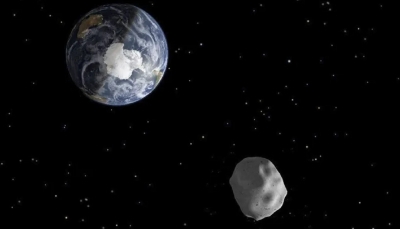
The European Space Agency (ESA) and the American NASA have mobilized their observation and monitoring systems for the asteroid 2024 YR4, which has a small possibility (1.5%) of impacting Earth on December 22, 2032.
The asteroid, which was discovered on the 27th, measures between 40 and 90 meters in diameter (in the event of hitting the planet it would not cause a global catastrophe), according to the latest data published by the ESA, although they will be refined as new observations are made.
A 98.5% chance that it will not impact Earth
The coordinator of the information service of the ESA's Planetary Defense Office, Juan Luis Cano, tells EFE that there is still "a 98.5% chance that it will not impact Earth, we do not want to transmit a catastrophic message to society", he indicates.
With the notifications issued last week by two institutions in charge of monitoring asteroids, "we are simply informing that, as experts and by our protocols, we have to pay special attention to this particular asteroid", Cano specifies.
The expert refers to the Space Missions Planning Advisory Group (SMPAG), chaired by the ESA and formed by space agencies, as well as the International Asteroid Warning Network (IAWN), chaired by NASA, in which, in addition to the agencies, the Near-Earth Object observatories and research centers related to asteroids are present.
Cano indicates that IAWN issued a notification of potential asteroid impact on January 29, which it must do when the observed body is larger than 10 meters and exceeds a 1% chance of impact.
Where would it fall in the event of a collision
The document indicates that, in the event of a collision, the risk corridor would be the eastern Pacific Ocean, northern South America, the Atlantic Ocean, Africa, the Arabian Sea and southern Asia, where "in the unlikely event of an impact" serious damage would occur due to explosion.
The SMPAG activates its warnings when the object, in addition to exceeding 1% of the possibility of impact, is more than 50 meters in size. This instance met last Friday and issued its warning on Sunday.
These are «attention notes - the expert reiterates - in which it is publicly explained that our groups have to do a special follow-up».
First time in 20 years of "such a relevant case"
Cano highlights that with 2024 YR4 it is the first time in 20 years that they have encountered «such a relevant case», the previous one was that of the asteroid Apophis, discovered in 2004, but from which the level of risk could quickly be reduced.
The SMPAG and the IAWN were created a decade ago, their warning protocols have been applied since 2018 and this is the first time they have been activated, adds the expert.
2024 YR4 can continue to be observed until April, when it will no longer be visible from terrestrial observatories as it will continue its trajectory, which will return it to the vicinity of our planet in 2028 and later in 2032.
Meeting in May
The SMPAG has decided to meet again next May, when more details of the characteristics and orbit of the object are available. If at that time the risk of impact is still above 1% and its size is more than 50 meters, the measures to be taken would begin to be discussed.
In any case, the asteroid will have a close passage to our planet again in December 2028, although it can be observed from April of that same year. That would be the occasion to, if it has not been done before, definitively establish the trajectory of the rock.
SMPAG and IAWN had already planned this Tuesday and tomorrow, Wednesday, a meeting with the United Nations Office for Outer Space Affairs (UNOOSA) to explain the development of their activities, which in view of the information on 2024 YR4 has changed its agenda to learn the details about the asteroid.
A "relatively small" object
2024 YR4 is a "relatively small" object, although its size is still to be determined with complete accuracy, so if it impacted Earth the damage could be similar to that caused in 1908 by a meteorite in Tunguska (Siberia), where it devastated an area similar to the Spanish island of Gran Canaria.
If the rock is below 50 meters, SMPAG would recommend the evacuation of the impact zone, Cano points out, but if it exceeds that size, other options would also be studied.
The American mission DART already demonstrated in 2022, with the impact of a probe against the small asteroid Dimorphos, that the kinetic impactor technology was viable to potentially defend the Earth from the threat of an object from space.


