
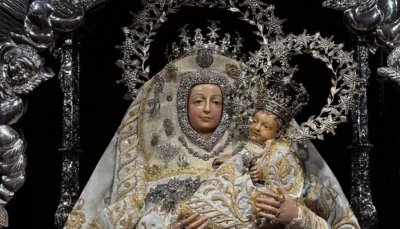
The aboriginal worship of the sky embodied in Chaxiraxi and Guayarmina was adapted by the conquerors until it became the most revered devotions in the Canary Islands: the Virgin of Candelaria and the Virgin of El Pino, among whose attributes the half-moon, the Sun, and the arc of stars still persist.
Historian Miguel A. Martín has investigated this issue in the book "Chaxiraxi. Religious Syncretism in the Canary Islands," published by Bilenio Publicaciones, which will be presented on October 24 at the State Public Library in Las Palmas de Gran Canaria, on the 30th of the same month in La Palma, and in Tenerife on November 12.
"Chaxiraxi. Religious Syncretism in the Canary Islands" is the result of Miguel A. Martín's research into how "a star traveling in the sky can become the Virgin Mary," and specifically alludes to the case of Candelaria, a festivity that, exceptionally, has two celebrations, February 2 and August 15.
Both dates share a peculiarity: the transit through the sky of Canopus, which has its evening rising on February 2 and reappears at dawn on August 15.
"And what is Guayarmina?: well, according to the translation by philologist Ignacio Reyes, it is "the spirit that protects us until the prolonged drought," that is, the star that appears in winter and marks the rains and fertility in crops and hides until summer, Canopus," the researcher points out.
Guayarmina is the name of the superior dynasty of "extremely important" women among the aborigines of Gran Canaria, since their leader, the guanarteme, had to marry a guayarmina in order to govern, Martín explains.
The early descriptions of this society indicated how the Canary Island natives venerated an enormous pine tree next to dragon trees and a spring, always accompanied by a morning star, a star.
Even in Genesis, in the Old Testament, there is talk "of a star that came down from the sky," identifying it with the mother of God, truly an incorporation of "pagan" elements from ancient societies in which the worship of female deities, of fertility, predominated.
The first inhabitants of the Canary Islands also lived in a matrilineal society, in which filiation is transmitted from mother to child, specifies Miguel A. Martín, who also details how Christianity transformed the ancient deities of Mesopotamia, Egypt, Greece, and Rome, the "mother goddesses," into the Virgin Mary.
"That is syncretism, the fusion, the mixture of cultural, astral, and religious elements in which one culture ends up prevailing over another, in this case Christianity, but still with disguised elements," Martín points out.
This fact "gives us an important basis for how the change from a star to the Virgin Mary occurs" and details of ancient astral cults persist in her image, such as the half-moon at her feet, the Sun, and the arc of stars, which were very difficult to change, the researcher adds.
And it's that Christianity "desacralized the sky but couldn't do it completely," and hence the syncretism to make the new religion "attractive" to the aborigines.
What the medieval Church really wanted to eradicate was the worship of the elements of the firmament, and that is why the indigenous calendar of the Canary Islands was "perfectly" adapted to the new cult of Candelaria and El Pino.
This led to all the patron saints, or in the words of Miguel A. Martín, "matrons," of all the Canary Islands being virgins with the child in their arms, which gives continuity to the sense of motherhood in the indigenous worldview.
And to whom does the Candelaria appear?: to the aborigines, not to the conquerors, since the idea of a miraculous apparition is another of the consequences of medieval Christianity of the time. They are Marian apparitions in remote places, such as caves, rocks, pine trees, crags, and other elements of nature identified with indigenous settlements or sacred places for them.
In fact, the first hermitages were established in places linked to the aborigines, such as the case of the Capellanía and the Candelaria (again) in Fuerteventura, which even has images of the Sun and two stars carved into a door and a window.
They are sites located at a crossroads of astronomical orientations, uniting space with time; that is, a settlement where time is marked by the sun rising or setting over pronounced mountains, Tindaya and Escanfraga, astronomical events that coincide again on February 2 and August 15.
Add La Voz de Lanzarote as a preferred Google source.
Stay informed with the latest current news.


