
The town of Nazaret in the municipality of Teguise is celebrating its festivities in honor of Our Lady of Nazaret. The board of directors of the Ubigue Socio-Cultural Center has prepared a modest program for children, young people and adults, complying with all the health protocols in force, as explained by the president of the association, Carmen Rosa González.
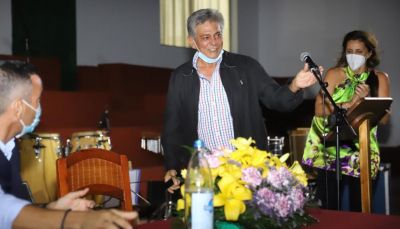
On Friday night, the sports courts of the Socio-Cultural Center hosted the reading of the proclamation. Carmen Rosa was in charge of presenting the event, which began with folias airs in the voice of the neighbor Desi Hernández accompanied on the timple by Raúl Caraballo and on the guitar by Gerardo Machín. Next, Dr. Enrique Hernández Ortega, cardiologist and resident of Nazaret, took the floor. Hernández made a proclamation illustrated with slides loaded with historical data from yesterday and today of the town where he was born. He revived for many of the neighbors present passages of a Nazaret that, despite having lost some of the old customs along the way, has evolved, currently placing itself like each and every one of the towns of Lanzarote.
The herald began by giving historical data about the hermitage of Our Lady of Nazaret, which was built in 1650. He also highlighted the construction of the only aqueduct in Lanzarote, built in the town's ravine to serve as the base for the pipeline that in times of drought carried water from the Famara galleries to Arrecife. This aqueduct was built in 1950 and he recalled that some young people from the town also went there to play.
Enrique was very mindful of the volcanic eruptions that occurred in Lanzarote in 1730, where the few families who lived in the town in those years had a very bad time. In 1961, some families, such as Enrique Hernández's, emigrated to Venezuela in search of a better future. The herald returned in 1967 and when he arrived in his town he was able to verify that there were still many deficiencies in his town, and he, who in Venezuela wore shoes with seven soles, had to change them for espadrilles, having to live again with the work of the countryside, surrounded by goats, camels and donkeys. A time in which he would also know the so-called "Barter", something very common where fish was exchanged for rabbits or cereals for potatoes or sweet potatoes.
The generosity of the neighbors in those times radiated from one end of the town to the other, such as those who worked as practitioners, nurses or midwives. The herald was very mindful of another of the neighbors, J. Espinosa, who for the children of the town was a Wise Man. Espinosa had a tremendous ability to make wooden trucks or also acting as a barber with some haircuts that are now back in fashion, all with a bun and shaved to one behind. Enrique finished his proclamation with some emotional words for those who are not here today, some of whom are very close to him "The past to learn, the future to dream, the present to live it".
The mayor Oswaldo Betancort presented him with a commemorative plaque and the performance of the Acatife group put the finishing touch to the night.


