
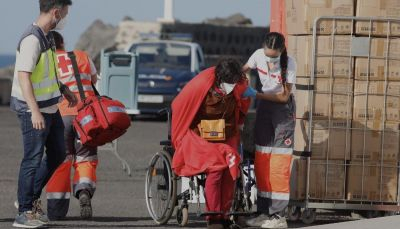
The Minister of Social Welfare, Equality, Youth, Children and Families of the Government of the Canary Islands, Candelaria Delgado, stated this Thursday that "a significant arrival" of migrant and refugee minors, women and families is expected to the archipelago in the coming weeks.
Candelaria Delgado made this consideration after a working meeting with Sophie Muller, the representative in Spain of UNHCR, the UN Refugee Agency, as specified by the regional Executive in a statement.
This meeting analyzed the challenge represented by the arrivals of unaccompanied migrant and refugee children, a particularly vulnerable group in which the needs for international protection may be greater than in adults due to the specific circumstances that motivate their departure and the absence of possibility of returning in the short term.
"It is therefore necessary to join forces to identify and protect refugee children and address the situation of immediate reception facilities in the Canary Islands," added the Minister.
To this end, the Government of the Canary Islands requests not only the solidarity of the other autonomous communities, but also compliance with the agreement reached within the framework of the XXVI Conference of Presidents of March 2022, where the need to welcome these children in a co-responsible manner within the Spanish territory was already evident, as well as the involvement of the European Union in this line since, she recalled, "the Canary Islands are the southern border of Europe."
According to data from the Ministry, so far this year a total of 186 boats and canoes have arrived to the islands, in which 1,598 unaccompanied minors, 1,483 boys and 115 girls were traveling. In addition, thirteen minors were reported missing and five lost their lives.
In this regard, the Minister indicated that in August there "has been a lower arrival of children in relation to previous months" although, she insisted, "we expect that the arrival of minors as well as women and families to our coasts seeking a better life opportunity will increase considerably" in the months of September and October.
"It is common for adult males to arrive first and, in subsequent waves, more migrant and refugee women and children join," she said.
This has been one of the issues that has focused the working meeting held in Tenerife with the head of UNHCR, Sophie Muller, in which "the need to continue and expand cooperation between both institutions in order to guarantee the legal and social protection of migrant and refugee minors" has been addressed.
In this regard, Muller reported on the "Guide for professionals working with unaccompanied refugee children" published by UNHCR together with the Comillas Pontifical University, and reiterated her "willingness to collaborate with the Canary Islands Government and, among other measures, support the group of asylum referents and the migrant and refugee children's table in the islands for the development of a protocol for action and support in cases of asylum for minors in the archipelago."
Likewise, the meeting addressed the "situation of women arriving by sea to the Canary Islands, as many of them are survivors of persecution for reasons of gender in their countries of origin, such as female genital mutilation, forced marriages or gender-based violence or during the route."
UNHCR recalled that "it is essential to manage the arrivals of migrant and refugee women from a gender perspective that guarantees a correct identification of their needs, as well as their protection and referral to appropriate assistance devices."


