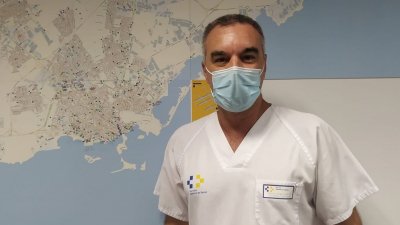
At the beginning of the pandemic he was the only tracker in Lanzarote and now he leads a team of 33 people, who work to stop the spread of the virus on the island. "It is an immense job and we need the collaboration of the population", said Baltasar Gómez, head of the Lanzarote tracking team.
In an interview on Radio Lanzarote-Onda Cero, Gómez explained that the work of the trackers already existed long before the coronavirus. "Not with the name of trackers, which is the name that has been assigned to the Covid-19 pandemic itself, but as case managers. With diseases such as tuberculosis or meningitis we have been doing the same thing", he pointed out. "The experience has served for this new virus, but the truth is that we have been working for 15 years", he added.
As a coronavirus tracker, Baltasar Goméz started on March 19, after the first positives were detected on the island. And "practically the first 90 cases in Lanzarote" were handled by him alone, until the team grew, first with "three more people" and now exceeding thirty.
More than 60 professionals dedicated to the coronavirus
According to him, in addition to the team of trackers, which currently consists of 33 people, Lanzarote has a team to monitor positive cases, which includes twelve people; a 112 incident team, where there are "three doctors managing calls and queries that arrive", a sample collection team made up of 17 people and another five people in the administrative unit.
"We are a total of 65 people who are currently dedicated to everything that has to do with the coronavirus", said Baltasar Gómez, pointing out that the tracking team is only "a part of that gear". "We are all important in that great team", he added.
In addition, he explained that these are "multidisciplinary teams", pointing out that, in the case of the tracking team, there are nine physiotherapists, 19 nurses and "even five professionals from the Military Emergency Unit". "Then we have resident doctors of family medicine, geriatric resident doctors who also contribute their grain of sand on weekends, nursing assistants, administrative staff and family doctors", he listed.
A study in the family, leisure, work or school environment
Regarding his daily work, the head of the tracking team explained that it begins when they have "a notification of the positive cases of the samples that are analyzed during the day or the day before". "Once we know those positives, we proceed to do the tracking work by calling the family", he indicated.
This study, he said, is carried out in three areas: in the family or cohabitation, in the area of recreational or leisure activities and in the work or school environment. "They are done in these three areas to identify all the people who meet the criteria to be a close contact", he said.
As he explained, close contacts are considered to be those people who, in the 8 hours prior to diagnosis or in the 48 hours prior to the onset of symptoms if they have them, have been with the infected person "less than one and a half meters away" "for more than 15 minutes and without the proper use of PPE, a mask". All people who meet this requirement would be "candidates to be included in the tracking study and to have the appropriate tests and follow-ups by the health teams of the monitoring unit or, depending on the result, by their primary care physician".
"Sometimes we find reluctance in people"
Regarding the response of citizens when the tracking team contacts them, Baltasar Gómez has indicated that "the population generally collaborates very well", although he has pointed out that "sometimes" he does notice "some reluctance" in people, especially in people who "have just got a job and are afraid of losing it".
"Sometimes we find that they are reluctant to answer our call or to tell us that they are in a certain place when perhaps the loudspeaker of a shopping center goes off and it is clear that, due to the ambient noise and so on, they are not at home", he added.
"This is not a trivial matter, it is something very serious"
In this regard, the head of the Lanzarote tracking team has reiterated the importance of the population following health recommendations, especially advocating the use of masks and even calling on people to tell those who do not wear them to do so "for our own good".
"Nobody is aware that they may have Covid, but this is happening. In Lanzarote, right now, you can see what is happening", said Baltasar Gómez, detailing also the "immense" work that the increase in cases of coronavirus on the island is entailing for his team.
For example, he pointed out that this Wednesday "399 samples were processed, of which 41 were positive". "We are talking about 10% of the tests analyzed positive, and if we calculate that of those 41 positives, around five or ten close contacts are tracked, then we are talking about 410 people that we have to identify, that we have to call, that we have to give advice...", he said. "We are very encouraged, very eager to do better if we can still do it, because there may be small failures and we are working to improve them, but we need the collaboration of the population. If they do not help, it will be difficult for us to do our job", he said.
Thus, the head of the Lanzarote tracking team also insisted on the importance of people complying with quarantines. "The fourteen days of isolation are difficult to comply with, but not impossible. It would be worse in the hospital with a tube in your mouth or having other ailments or fever. So, let's not relax. This is not a trivial matter, it is something very serious", concluded Baltasar Gómez.
Add La Voz de Lanzarote as a preferred Google source.
Stay informed with the latest current news.