
The fourth campaign of systematic paleontological intervention of the continental Neogene sites of Órzola closes with important advances, including the extraction of another complete ratite egg, the eighth found since work began in 2010 in these excavations. Ratites are ostriches that lived more than six million years ago, and so far it has not been possible to explain how they arrived on the island.
The campaign developed in the Famara massif has been fully financed by the Cabildo of Lanzarote, and the City Council of Haría has also collaborated with logistics and the improvement of the roads to facilitate transit to the sites.
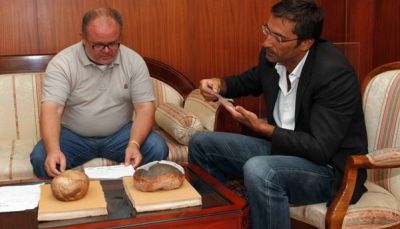
The president of the Cabildo, Pedro San Ginés, accompanied by the Councilor for Historical Heritage, Juan Antonio de la Hoz, was able to learn this Thursday the results and latest findings found in this area of the island. The councilor explained that "the most interesting thing about this egg collected this summer is that part of its shell has disappeared after its fossilization. The volume and shape of the egg has been maintained, but the shell has been partially lost, so it is possible that this will help to understand why bones are not found - with rare exceptions - in these sites."
He also detailed that in addition to this new whole fossil egg, half a ratite fossil egg has appeared in an area that has not been excavated in Fuente de Gusa, although it has been prospected. This specimen is of a different type from all those found by this team so far, making its discovery novel.
Other findings
Similarly, specialists have located and excavated two bones. One is a small shell bone (scapular) from a turtle neonate and the other is a vertebra that, although preserved quite deteriorated, may belong to the snake that is already known and of which there is a vertebra of its skeleton collected in the 2010 campaign.
The researchers' report also provides other relevant data. They emphasize that one of the objectives set from the beginning in 2010 when the works began has been achieved. Valle Grande 1 has been chronologically related to Valle Chico. "The suspicions that both sites were not formed at the same time have been confirmed, which extends the period of time in which the first known terrestrial fauna of the Canary Archipelago developed in them," the report from the Historical Heritage area emphasizes.
They emphasize that on this occasion more time has been dedicated than in previous years to another site, related to Valle Chico, so it is believed that the chronology of the fauna that is being studied can be further specified. In particular, datable geological samples have been obtained, so it is possible to provide a fairly approximate date to the arrival of some of the animals that made up this ancient community developed in an ecosystem with the presence of fresh water.
This new excavation advances the research on the mysterious presence of these birds in Lanzarote, since "there is no record anywhere else in the world of ostriches (ratites) on islands that emerged from the oceanic crust, and their origin and how they arrived on the Island remains a subject of study."
In this last campaign, 30 specialists in the field worked, from August 4 to 24, in three different topographical points: Fuente de Gusa, Valle Chico and Valle Grande 1. The works, as in previous campaigns, have been directed by Antonio Sánchez Marco, researcher belonging to the Catalan Institute of Palentology Miquel Crusafont.


